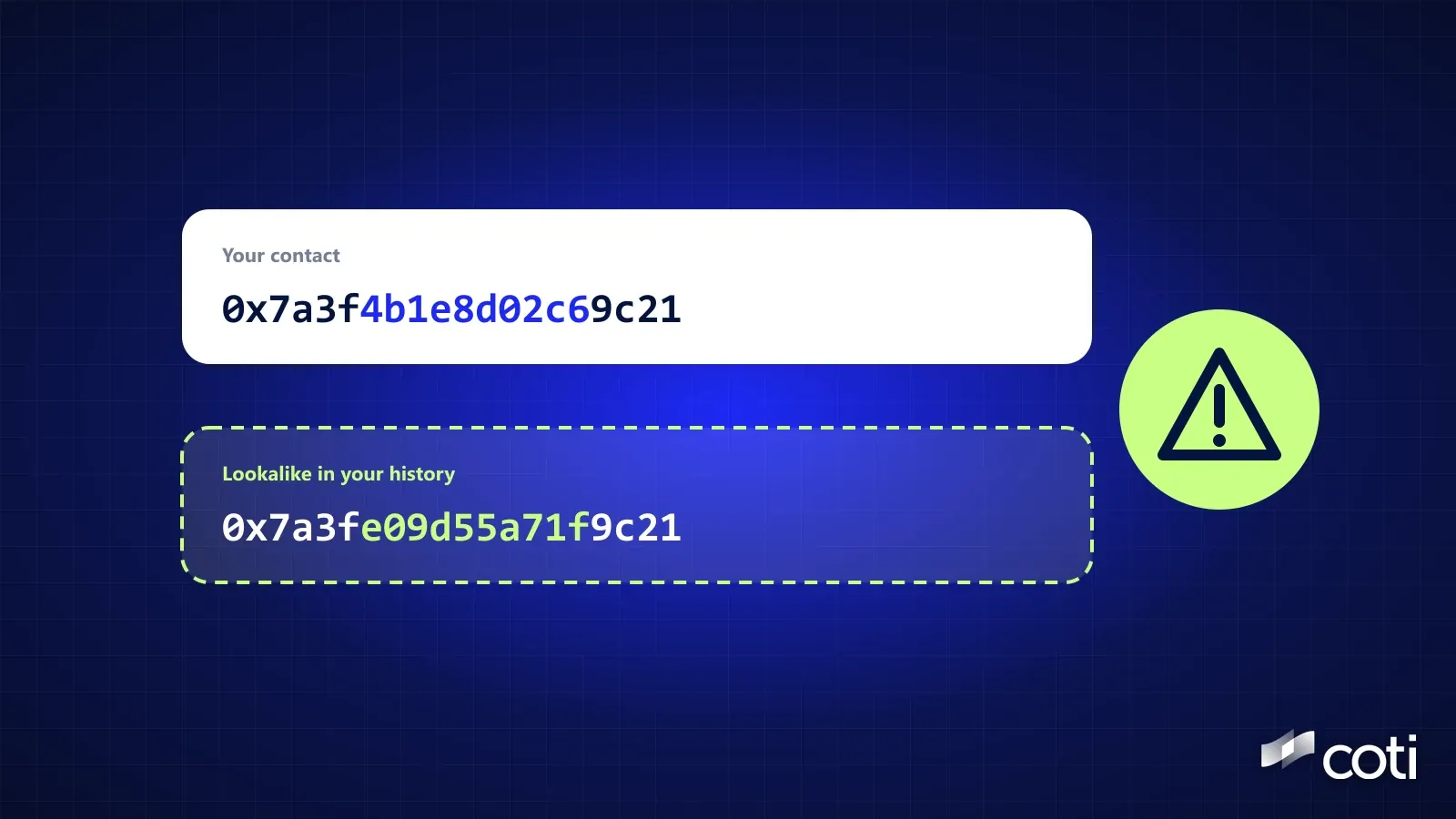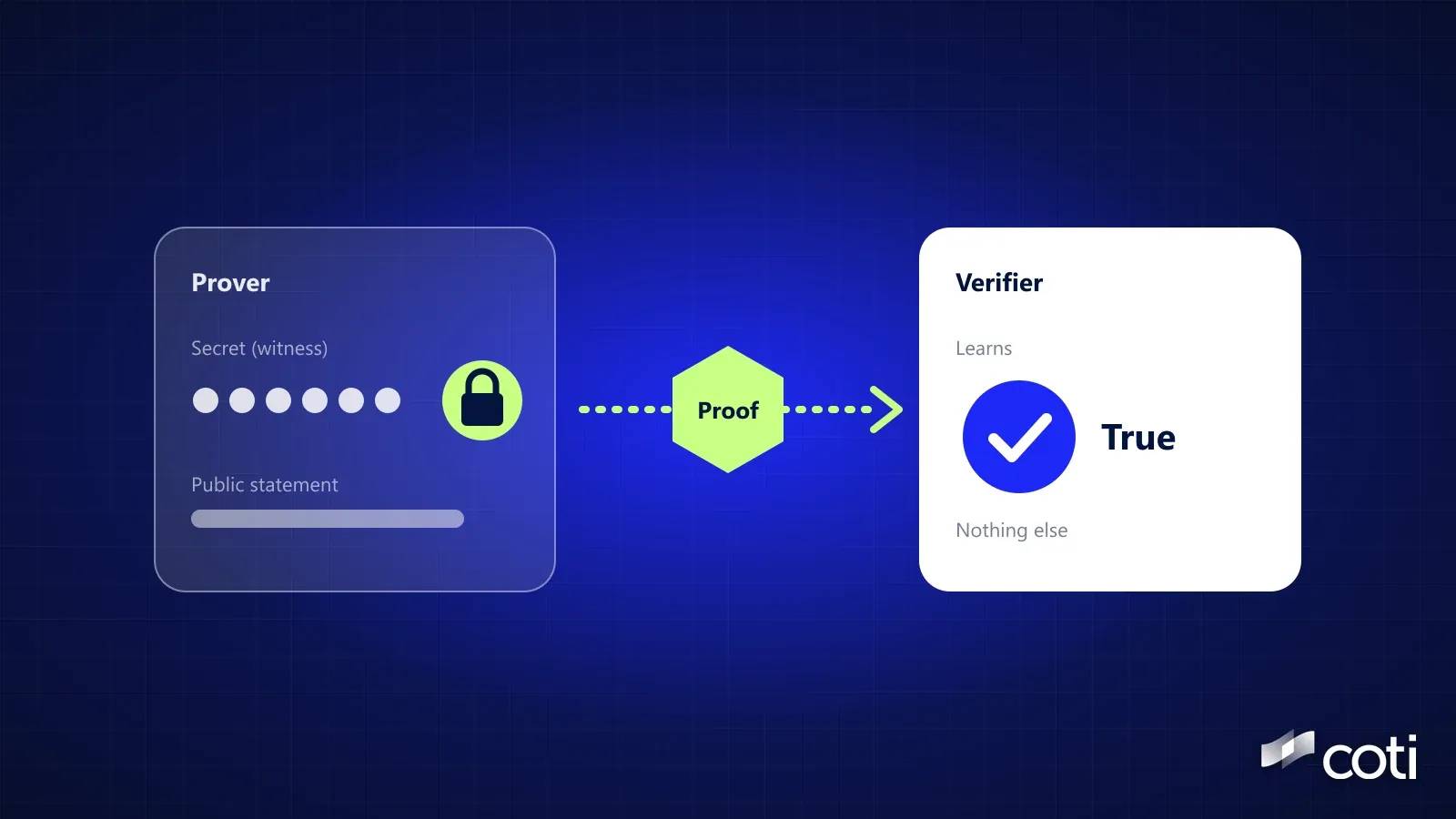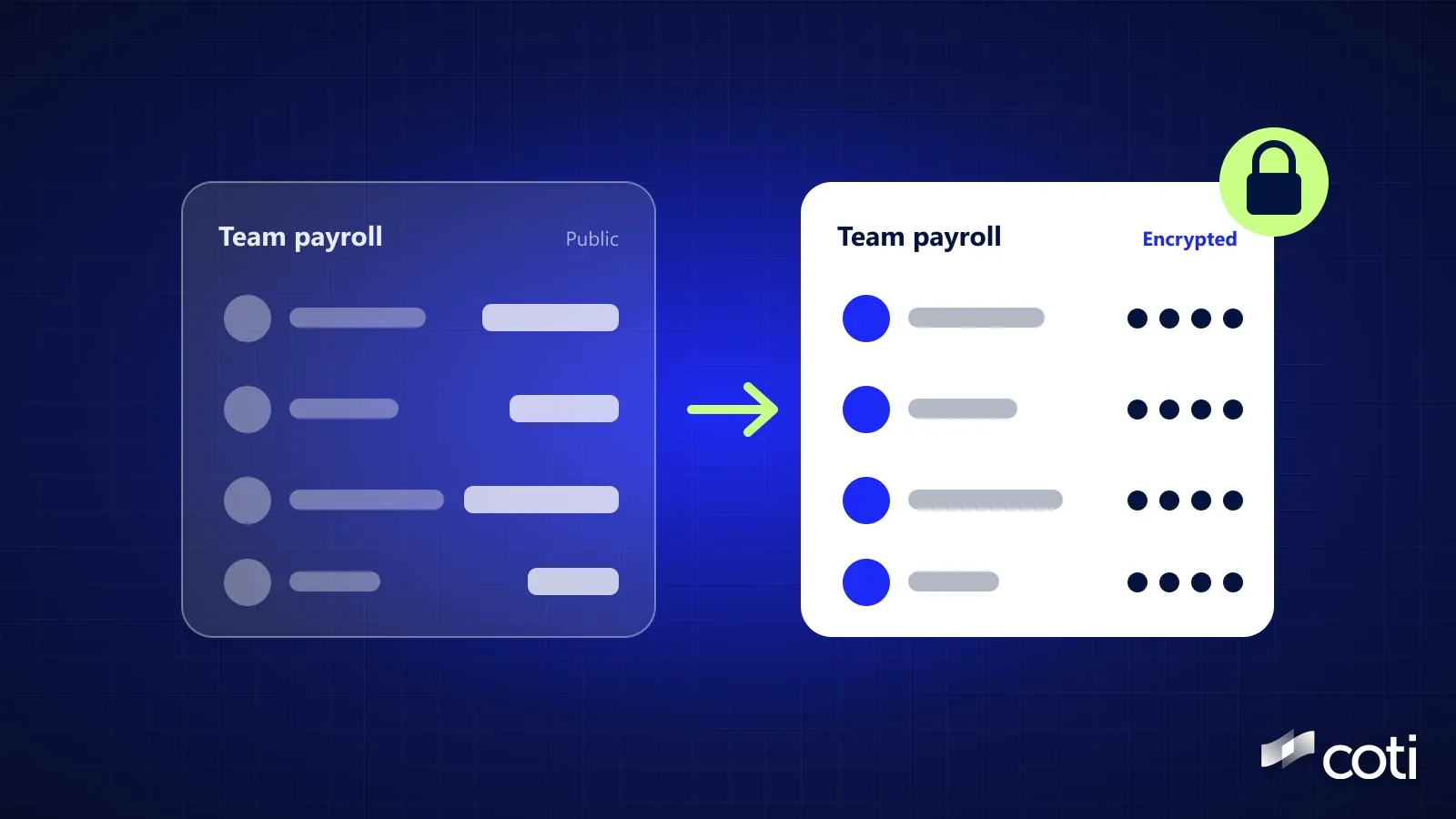
Crypto payroll means paying employees or contractors in crypto, usually stablecoins such as USDC or USDT. On a public blockchain, every one of those payments is recorded for anyone to read. Anyone who knows the address you pay from can see each payout, its amount, the recipient's address and the date, and if you pay everyone from one address, each person can look up every other payout from it, even without knowing which colleague owns which address. Private payment tools can hide amounts, and in some designs recipients, from the public, but none of them removes your tax or data protection duties.
Current as of October 14, 2026.
The Short Answer
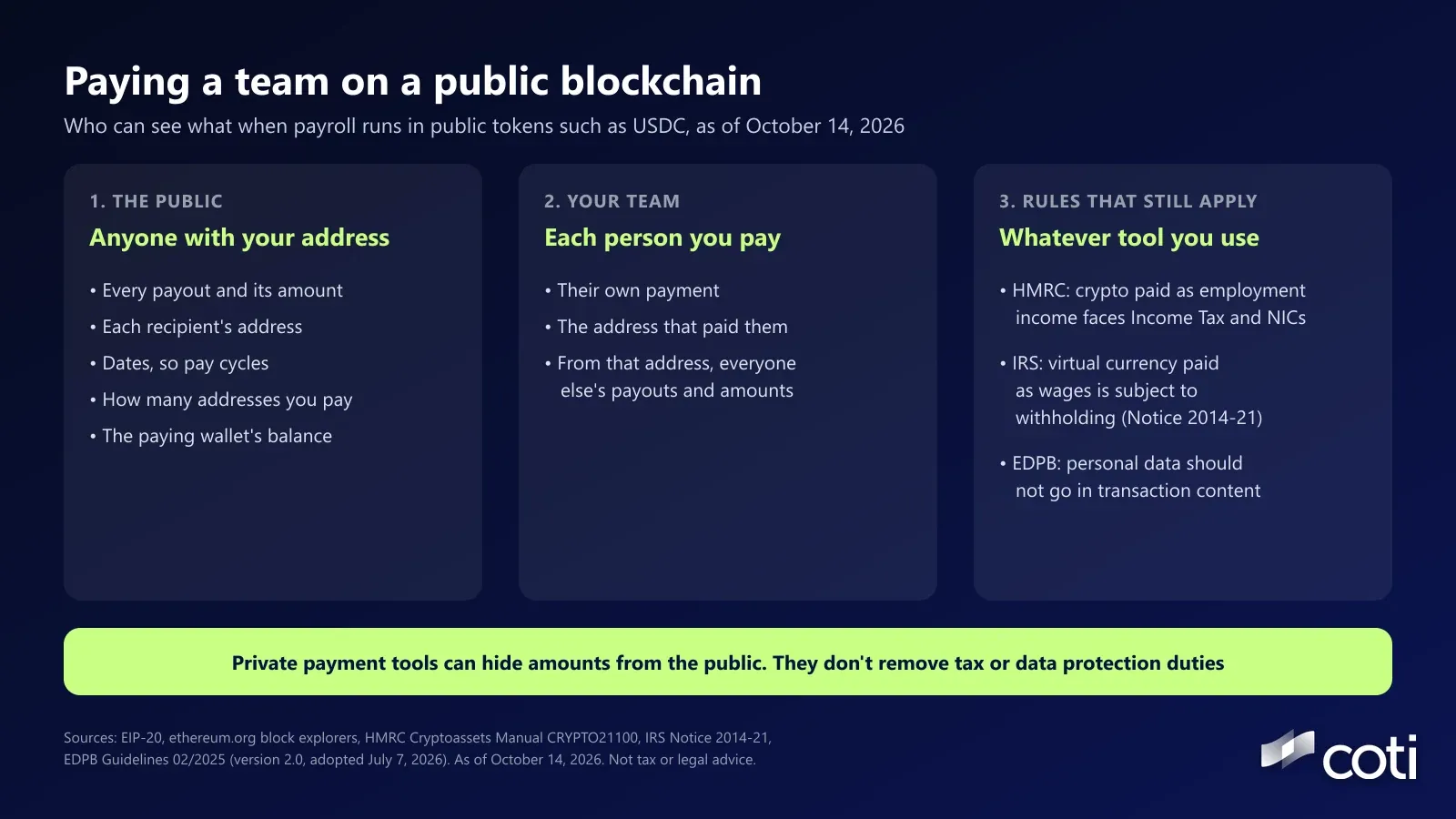
What a public payroll reveals
- Every payout, its amount and its date
- The address of each person you pay
- How many addresses you pay, and how often
- The balance of the wallet you pay from
Who can see it
- Anyone who knows your paying address
- Every person you pay, since their own payment shows them the address it came from
What private options exist, as of October 14, 2026
- Live: private stablecoin payments on Polygon, confidential USDC and USDT on Ethereum through Zama, and private USDC on Avalanche through COTI's Privacy Portal
- In development or planned: confidential transactions on Circle's Arc network, and COTI's private multisender and team payroll
What a Public Payroll Reveals
Stablecoins like USDC on Ethereum follow the ERC-20 token standard. Its specification requires a Transfer event, with the sender, the recipient and the amount, every time tokens move. Block explorers display that record for any address, including its full transaction history.
For an employer, that turns payroll into a public ledger:
- Your team can compare pay. Each person sees the address that paid them. If everyone is paid from that address, looking it up shows every other payout and amount. People may not know which address belongs to whom, but the spread of salaries is visible.
- Outsiders can read your business. Headcount, pay cycles, salary ranges and the paying wallet's balance are all there for a competitor, a recruiter or a scammer who learns the address.
- Your people become easier to target. A visible regular income makes a wallet more interesting to phishers, and our guide to who can see your crypto wallet explains how addresses get linked to names.
Some organisations choose this openness. The ENS DAO, for example, publishes the total it pays its working group stewards in quarterly spending summaries in its governance forum. That's a policy decision. For most companies, public payroll is a side effect, not a choice.
Using a New Wallet Doesn't Fix It
Paying from a fresh address each month helps less than it seems. The new address has to be funded, usually from your main wallet, and that transfer is public too. As bitcoin.org warns, moving funds between your addresses ties them to each other's history. The same logic applies on Ethereum, where a new address also needs ETH for fees, which is another visible transfer. Splitting wallets reduces casual lookups but doesn't hide pay from anyone who follows the money.
Rules That Apply Whatever Tool You Use
Privacy from the public doesn't change what you owe authorities or your staff. Two tax authorities, as examples:
- United Kingdom: HMRC's Cryptoassets Manual says cryptoassets received as employment income are subject to Income Tax and National Insurance contributions. Where they count as readily convertible assets, the employer must account to HMRC for the tax and contributions due.
- United States: IRS Notice 2014-21 says the fair market value of virtual currency paid as wages is subject to federal income tax withholding, FICA and FUTA taxes, and must be reported on Form W-2. The IRS digital assets page lists stablecoins as digital assets and says employees and contractors paid in them report that income.
Data protection matters too. In its updated blockchain guidelines, adopted after public consultation on July 7, 2026, the European Data Protection Board states: "In general, it is not advisable to store personal data on the blockchain, and it should not be stored in the content of transactions." In practice, that's a reason to keep names, payslips and notes out of transaction memos. How these rules apply to you depends on where you and your team are, so check with an adviser.
Private Payroll Options, and Their Status
Each option below hides different things. None is a payroll service by itself, and all of them still involve moving funds in and out of private form, which is usually visible. These projects are not affiliated with COTI.
Polygon private payments (live since May 2026)
- Polygon announced private payments for USDC and USDT in its wallet on May 4, 2026, provided through the Hinkal protocol. It lists vendor and contractor payments among example uses and cites payroll exposure as part of the problem it addresses.
- Polygon says outside observers can't see the participants or the amount, and every private transaction is screened before it runs.
Confidential USDC and USDT on Ethereum (live, per Zama's May 2026 update)
- Zama said on May 7, 2026 that its official confidential token wrappers are live on Ethereum mainnet, with USDC and USDT among the supported tokens. Zama says it ran a confidential payroll on mainnet with the wallet company Bron in January 2026.
- Zama says sender and receiver addresses remain public while amounts and balances stay encrypted (more in our guide to confidential tokens).
Circle Arc confidential transactions (in development)
- Circle describes confidential transactions and balances with view keys as in development for network-wide release, as of its September 2026 Arc mainnet announcement.
COTI (live today, payroll features planned)
- Live, per COTI (announced September 16, 2026): COTI's Privacy Portal on Avalanche turns USDC into a private version with an encrypted balance and amounts. Addresses and the fact a payment happened stay visible, since COTI says its privacy encrypts values, not the fact that a transaction happened. It has no payroll features yet, per COTI's roadmap.
- Planned (Q4 2026 to Q1 2027): a private multisender that pays up to 100 recipients in one transaction while keeping each amount private from the others.
- Planned (Q2 to Q3 2027): team payroll. COTI's roadmap describes it as: "Pay your entire company or DAO team in stablecoins (USDC/USDT) or crypto in one click, without team members seeing each other's salaries."
- Planned (Q2 to Q3 2027): read-only, time-limited sharing with accountants, auditors or tax authorities.
Roadmap items are as of October 14, 2026 and may change. More on how private stablecoins work, and what issuers can still do, is in our guide to stablecoin privacy.
What to Check Before You Choose
Who can see amounts
- The public, your team, the provider, or only sender and recipient
Who can see recipients
- Some tools hide only amounts, others hide participants too
Can each person verify their own pay
- People need to confirm what they received, ideally without seeing anyone else's
Accountant and auditor access
- Look for a way to share specific records without exposing everything
Compliance and terms
- Polygon screens every private transaction before it runs, and the Privacy Portal's terms allow wallet screening and blocking. Check what your tool screens, and whether it can give auditors or tax authorities access
Getting in and out
- Converting into and out of private form, and cashing out through an exchange, usually leaves a visible trail. If you convert a whole payroll budget at once, that total can show, and each person's conversion back to public tokens can reveal their own pay
Frequently Asked Questions
Can employees see each other's salaries if I pay in crypto?
On a public blockchain, yes, if you pay everyone from the same address in a regular token like USDC. Each person can look up that address and see every payout and its amount. They may not know which address belongs to whom, but the spread of salaries is visible.
Is it legal to pay salaries in crypto?
It depends on the country, and sometimes on the type of worker. HMRC and the IRS both treat crypto pay as taxable earnings or wages, according to their own guidance, but whether and how you can pay in crypto is a question for a local adviser.
Can I pay contractors in stablecoins privately?
Partly, today. Live tools can hide amounts, and in some cases participants, from the public, but funding and cashing out usually remain visible, and tax reporting still applies.
Where to Go From Here
If you pay a team in crypto today, assume every payout is public unless your tool says otherwise, and keep personal details off-chain. To follow COTI's private multisender and team payroll, which are planned between Q4 2026 and Q3 2027 as of October 14, 2026, see COTI's roadmap.
Details checked October 14, 2026. Rules and product status can change. Nothing here is financial, legal or tax advice. Polygon, Zama, Circle and the ENS DAO are not affiliated with COTI. COTI will never ask for your seed phrase or private key, and only COTI's official channels (coti.io, docs.coti.io, COTI's Medium blog and its official X and Telegram) carry announcements.
Sources
- ERC-20: Token Standard, Ethereum Improvement Proposals, accessed October 14, 2026
- Block explorers, ethereum.org, accessed October 14, 2026
- ENS working group spending summaries, ENS governance forum, latest summary posted May 19, 2026, accessed October 14, 2026
- Protect your privacy, bitcoin.org, accessed October 14, 2026
- CRYPTO21100: Earnings from employment, readily convertible assets, HMRC Cryptoassets Manual, updated November 28, 2025, accessed October 14, 2026
- Notice 2014-21, IRS, 2014, accessed October 14, 2026 (Q&A 11. Background section modified by Notice 2023-34, Q&As unchanged)
- Digital assets, IRS, accessed October 14, 2026
- Guidelines 02/2025 on processing of personal data through blockchain technologies, European Data Protection Board, version 2.0 adopted July 7, 2026, accessed October 14, 2026
- Private payments are live on Polygon, Polygon, published May 4, 2026, accessed October 14, 2026
- Zama Protocol update: new SDK, delegated decryption, developer tooling and protocol apps, Zama, published May 7, 2026, accessed October 14, 2026
- The first confidential payroll on Ethereum mainnet, Zama, published January 16, 2026, accessed October 14, 2026
- Confidential onchain payroll, Zama, accessed October 14, 2026
- Circle launches Arc mainnet, Circle, published September 16, 2026, accessed October 14, 2026
- COTI x Avalanche: Privacy Built for Business, COTI, published September 16, 2026, accessed October 14, 2026
- Privacy-on-Demand: How Privacy Works Across Chains, COTI, published September 1, 2026, accessed October 14, 2026
- Roadmap, COTI, accessed October 14, 2026