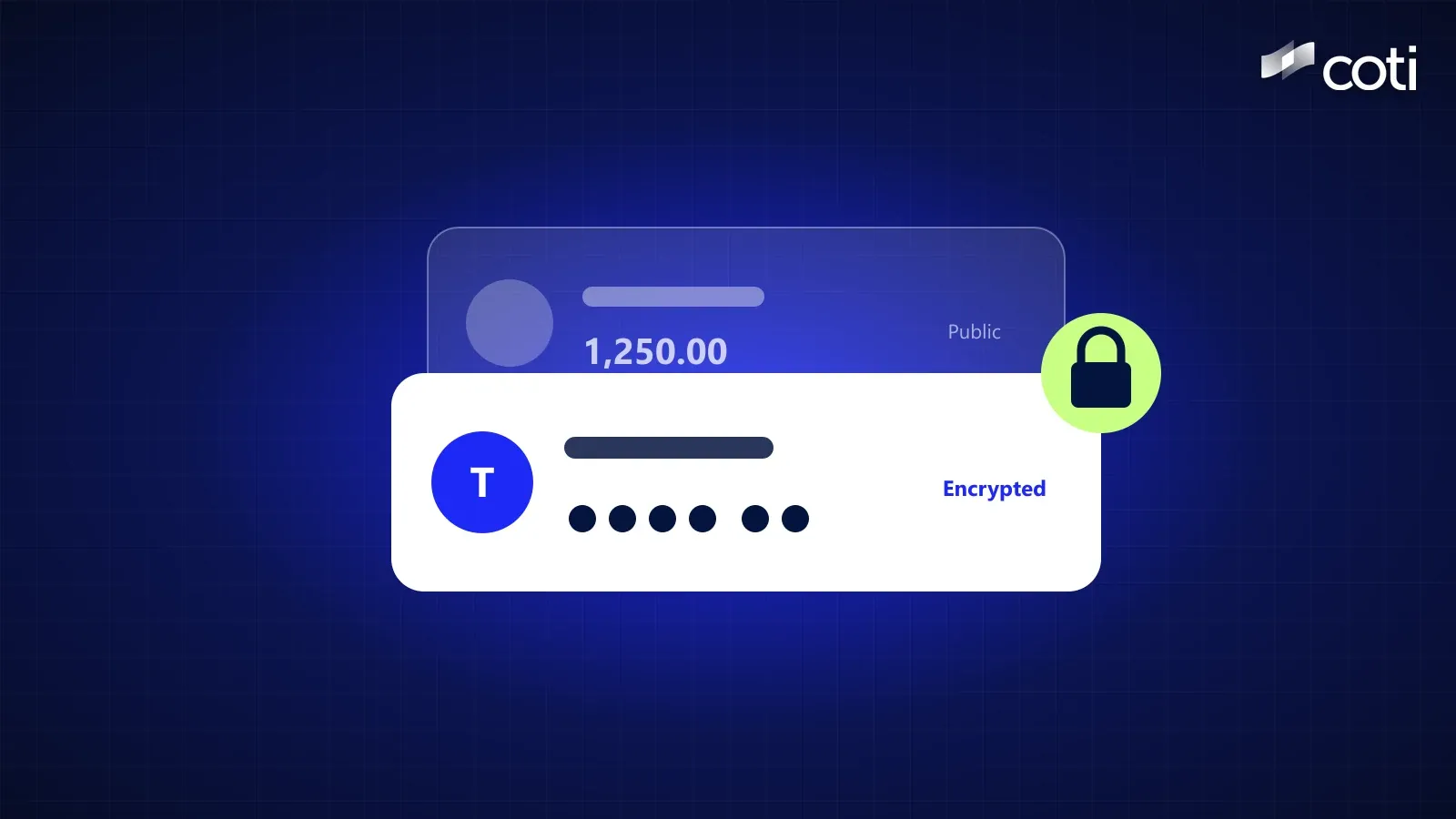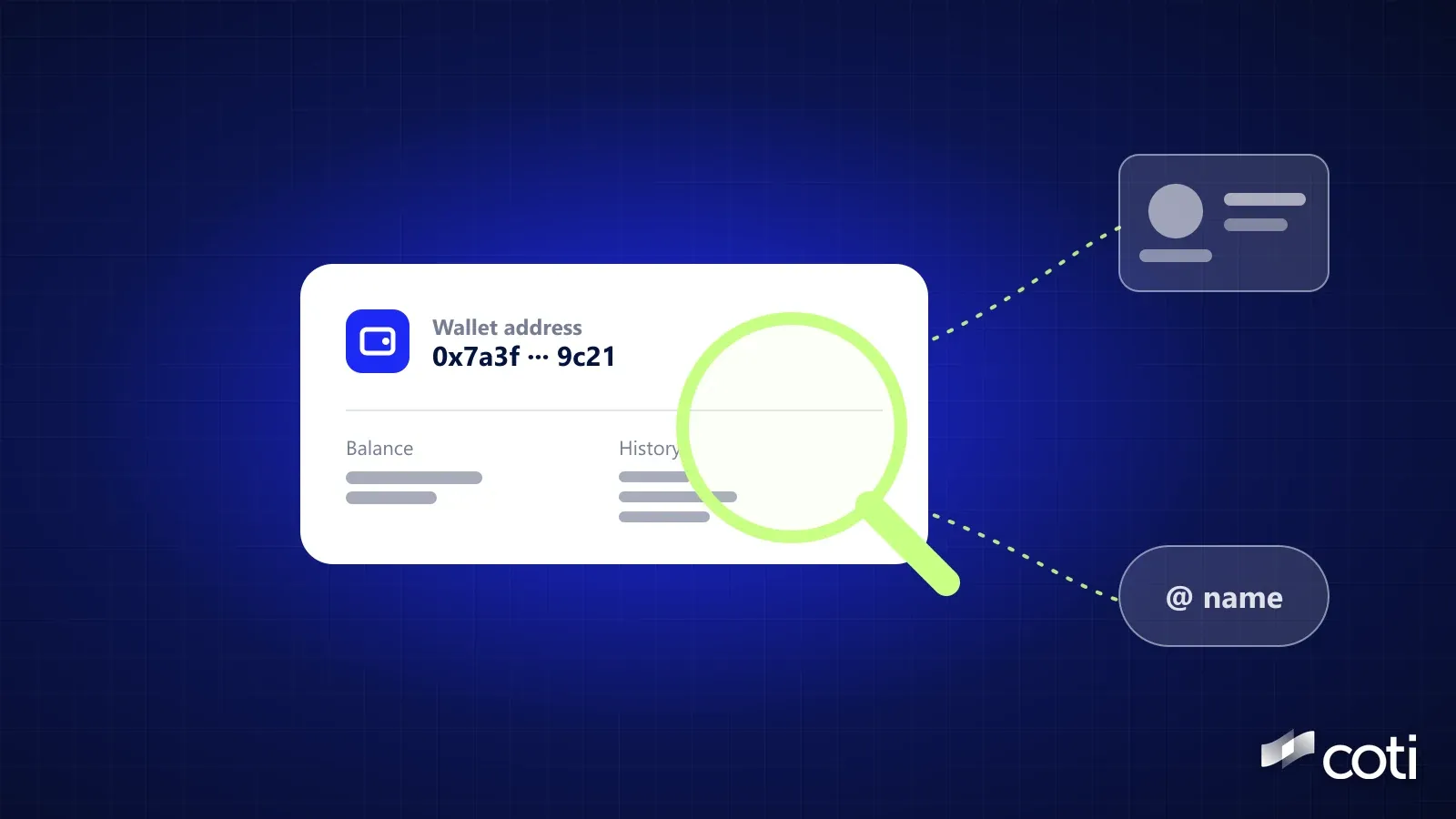
Yes, anyone who knows your crypto wallet address can see its balance and full transaction history on public blockchains such as Bitcoin and Ethereum. What the chain doesn't record is who you are, unless you've attached a public name to the address. The real privacy question is who can link that address to you, and the usual answer is exchanges, the things you publish, patterns on the chain and the apps you use. None of this lets anyone move your funds. Only your private key or seed phrase can do that.
Current as of October 13, 2026.
The Short Answer
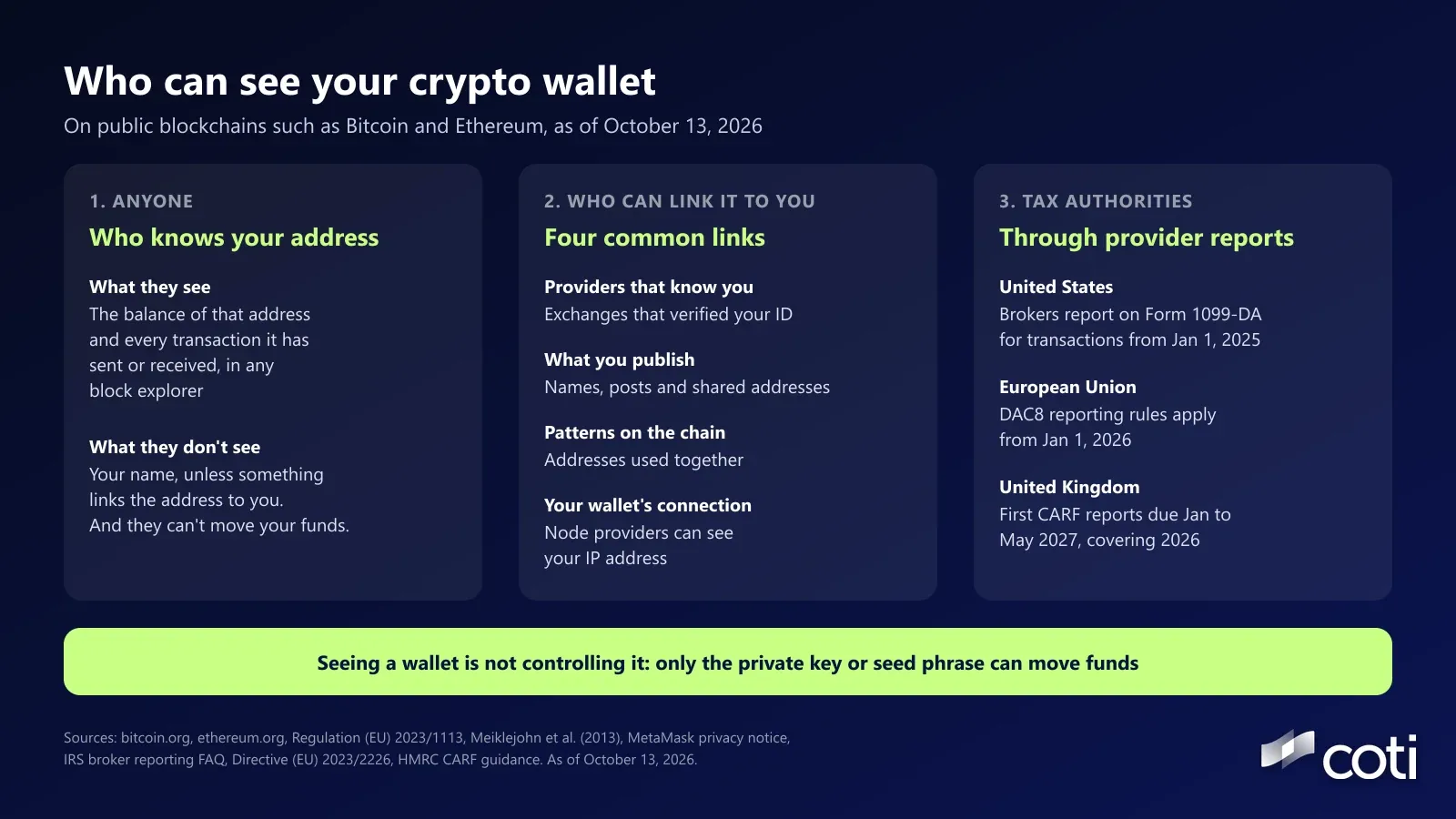
What anyone can see
- The balance of any address they know
- Every transaction that address has sent or received, with amounts and dates
What they can't see from the chain alone
- Your identity, unless you've linked a public name to the address
- Your private key or seed phrase
Who can usually link an address to you
- Exchanges and other providers that verified your identity
- Anyone who sees your address next to your name, such as a public post or a wallet name
- Analysts who connect addresses through patterns
- The app or node provider your wallet connects through, which can see your IP address
What Anyone Can See
Public blockchains are built so that anyone can check every transaction. Bitcoin's community site, bitcoin.org, says it plainly: "Anyone can see the balance and all transactions of any address." The ethereum.org privacy page calls Ethereum a public and transparent ledger by design, and its block explorer guide lists an account's ETH balance and its transaction history among the data anyone can look up.
So if you share your address to get paid, the payer can look up what else that address holds and has done. That's the main reason to think before you reuse or publish an address.
What an address doesn't show is who owns it. It's a string of characters, not a name. The privacy risk comes from the links between that string and you.
How a Wallet Gets Linked to You
Exchanges and other providers that know you
When you buy crypto on an exchange that verified your identity and withdraw it to your wallet, the exchange knows that address received funds from your account. In the EU, Regulation (EU) 2023/1113 has required crypto-asset service providers since December 30, 2024 to make sure the sender's name and blockchain address, among other details, accompany crypto transfers to another provider (Article 14). That information passes between providers and doesn't have to be included in the on-chain transfer. For transfers to a self-hosted wallet, the provider must obtain and hold that information too.
What you publish
Posting your address on social media or a website ties it to that account. Naming services work the same way. The ENS documentation describes a reverse record as a mapping from an address to an ENS name. When the name also points back to that address, it becomes a primary name, which apps can show instead of the address. If that name is also your handle, the link is public.
Patterns on the chain
Analysts can group addresses that probably belong to the same person. A 2013 study of Bitcoin by Meiklejohn and others used a simple rule: addresses spent together as inputs in the same transaction are likely controlled by the same user. bitcoin.org also warns that moving funds from a published address to your other addresses links them to its history.
The app your wallet connects through
Your wallet reads the blockchain through a node, often run by a provider. MetaMask's privacy notice (last revised September 30, 2026) names Infura as its default node provider, says it may temporarily process IP addresses for some services, and says users who set up MetaMask with a Secret Recovery Phrase can switch these defaults off with its Basic Functionality setting. Our guide to spending crypto privately covers what node providers see when you pay.
Can Tax Authorities See Your Crypto Wallet?
Tax authorities don't need special access to see a public address, but the bigger change is what providers now report to them. These are reporting duties for exchanges and brokers, as of October 13, 2026:
- United States: brokers report on Form 1099-DA, beginning with transactions on or after January 1, 2025, according to the IRS.
- European Union: under Directive (EU) 2023/2226, known as DAC8, EU countries had to apply the new crypto reporting rules from January 1, 2026, with information reported in the year after the year it covers, so 2026 activity is reported in 2027.
- United Kingdom: under the Cryptoasset Reporting Framework (CARF), providers of cryptoasset services in the UK must send their first reports between January 1 and May 31, 2027, covering 2026, according to HMRC.
These rules cover what providers know about their customers. Combined with a public blockchain, they make it easier to connect activity to people. Privacy tools don't change your tax obligations, and nothing here is tax advice.
Can Someone Take My Crypto if They See My Wallet?
No. Seeing an address doesn't give anyone control of it. Only the private key or seed phrase can move funds, so never share either.
Visibility does enable scams. MetaMask's help centre describes address poisoning: a scammer sends you a tiny transaction from an address that looks like one you've used, hoping you'll copy it from your history next time. MetaMask advises against copying addresses from your transaction history and suggests checking the middle characters, not just the start and end.
Practical Ways to Show Less
These steps reduce what strangers can piece together. They don't hide anything from providers that already know you.
- Use a new address for each payment you receive. bitcoin.org recommends it, and many Bitcoin wallets can generate a fresh receiving address for you.
- Keep separate wallets for separate purposes. A wallet you share publicly shouldn't hold your savings. Moving funds between them links them on-chain.
- Think before you publish. Posting an address or setting a public name on it ties it to you.
- Check your wallet's connection settings. Some wallets let you change the node provider or opt out of default data settings.
- Look at tools that hide more. Stealth addresses, a final Ethereum standard (ERC-5564) as of October 13, 2026, give each payment a fresh receiving address. Confidential tokens encrypt balances and amounts while addresses stay visible.
Where COTI Fits, and Where It Doesn't
COTI's live privacy tools work by encrypting values, not by hiding that activity happened.
- Live, per COTI (announced September 16, 2026): COTI's Privacy Portal on Avalanche turns AVAX and USDC into private versions whose balances and amounts are encrypted, readable with the holder's own keys. COTI's developer docs still describe the underlying Privacy-on-Demand stack as under active development, as of October 13, 2026. The Portal's terms of use, from operator CV2 Innovation Limited, allow sanctions and wallet screening and give no guarantee that any transaction will be hidden from any person or authority (checked October 11, 2026).
- What stays visible: your wallet address and the fact that a transaction happened. COTI's docs are direct about the limits: "PoD does not hide metadata such as gas costs, timing or which contract was called." Moving tokens into and out of private form is also a visible on-chain step, as with most such tools.
- Planned (Q4 2026 to Q1 2027, per COTI's roadmap as of October 13, 2026): private transfers across Ethereum, Solana, Bitcoin and TRON.
So COTI can make your balance and amounts private on supported networks. It doesn't hide your wallet or its activity, and it doesn't affect what an exchange already knows about you.
Frequently Asked Questions
Can someone find my name from my wallet address?
Not from the blockchain alone. They need a link, such as an exchange record, a public post, a wallet name or patterns that connect your addresses. bitcoin.org notes that because people usually have to reveal their identity to receive goods or services, an address can't be counted on to stay private.
Is my wallet balance private on Ethereum?
No. Ethereum balances and transactions are public by default and can be looked up in any block explorer. Encrypted options exist, such as confidential tokens, but they work only for supported tokens and apps.
Does a hardware wallet make my wallet private?
No. A hardware wallet keeps your private key off your computer or phone, which makes it harder to steal. Your address, balance and history are just as public as with any other wallet.
Where to Go From Here
Treat a wallet address like a public account number: anyone who has it can read it, so share it on purpose. To follow where COTI's privacy features stand, including the cross-chain private transfers planned for Q4 2026 to Q1 2027 as of October 13, 2026, see COTI's roadmap.
Details checked October 13, 2026. Rules and product status can change. Nothing here is financial, legal or tax advice. MetaMask, ENS and Infura are not affiliated with COTI. COTI will never ask for your seed phrase or private key, and only coti.io, docs.coti.io and COTI's official X and Telegram carry announcements.
Sources
- Protect your privacy, bitcoin.org, accessed October 13, 2026
- Privacy on Ethereum, ethereum.org, accessed October 13, 2026
- Block explorers, ethereum.org, accessed October 13, 2026
- Regulation (EU) 2023/1113 on information accompanying transfers of funds and certain crypto-assets, Official Journal of the EU, published June 9, 2023, accessed October 13, 2026 (Articles 14 and 40)
- Primary Names, ENS documentation, accessed October 13, 2026
- A Fistful of Bitcoins: Characterizing Payments Among Men with No Names, Meiklejohn et al., IMC 2013, accessed October 13, 2026
- Privacy notice, MetaMask, last revised September 30, 2026, accessed October 13, 2026
- Frequently asked questions about broker reporting, IRS, accessed October 13, 2026
- Council Directive (EU) 2023/2226 (DAC8), Official Journal of the EU, published October 24, 2023, accessed October 13, 2026
- Reporting cryptoasset user and transaction data, HMRC, updated June 3, 2026, accessed October 13, 2026
- Address poisoning scams, MetaMask help centre, accessed October 13, 2026
- ERC-5564: Stealth Addresses, Ethereum Improvement Proposals, accessed October 13, 2026
- COTI x Avalanche: Privacy Built for Business, COTI, published September 16, 2026, accessed October 13, 2026
- Privacy on Avalanche (PoD) for dummies, COTI documentation, accessed October 13, 2026
- Privacy-on-Demand, COTI documentation, accessed October 13, 2026
- Roadmap, COTI, accessed October 13, 2026
- Privacy Portal terms of use, CV2 Innovation Limited, accessed October 11, 2026