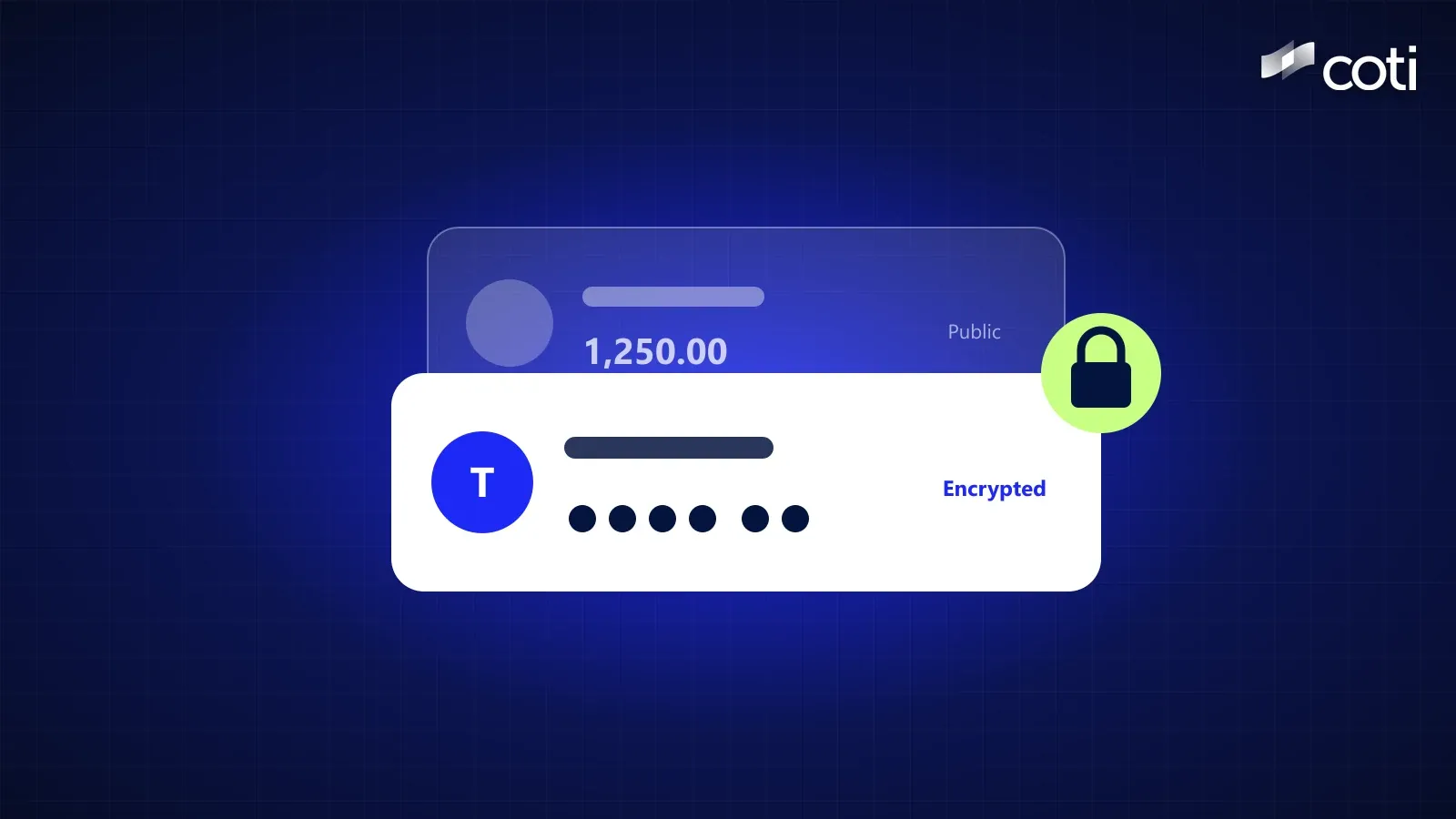
Stablecoin privacy starts close to zero: on Ethereum and similar chains, every USDC or USDT transfer is a public record of sender, recipient and amount, and the issuer can block addresses and freeze tokens. A new wave of privacy tools changes the first part, hiding amounts or parties from the public. They don't remove issuers' controls or their legal duties. This guide sets out who can see a stablecoin payment, who can act on it, what US law will require of issuers from January 2027, and what the main privacy options, including COTI's Privacy Portal, actually change.
Current as of October 11, 2026.
The Short Answer
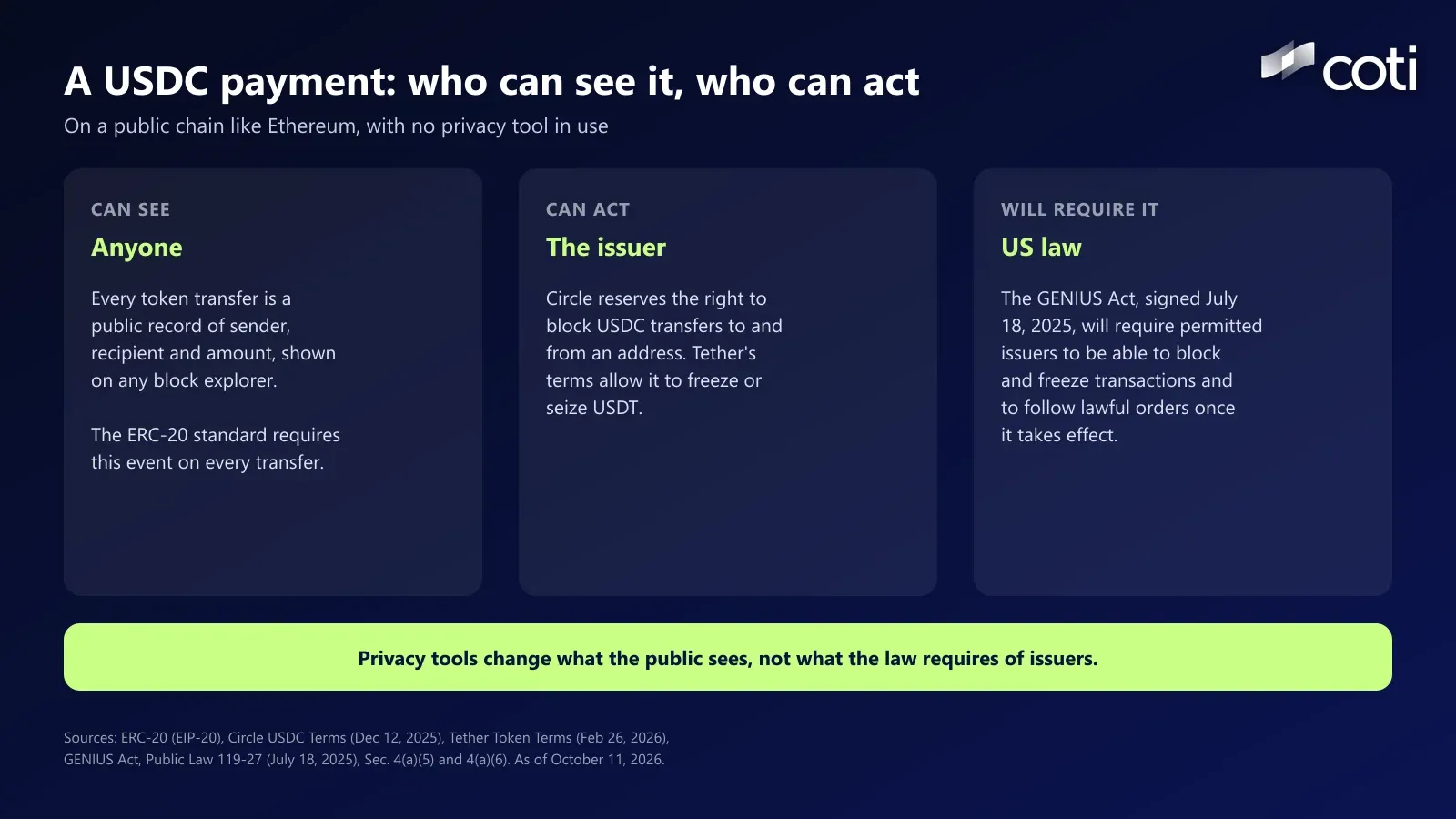
Who can see a regular stablecoin payment
- Anyone with a block explorer: sender, recipient and amount, permanently
- The exchange you bought from: your identity, linked to the address you withdrew to
Who can act on it
- The issuer: Circle reserves the right to block addresses, and Tether's terms allow freezing
- US law: the GENIUS Act will require permitted issuers to be able to block and freeze, and to follow lawful orders, from January 2027
What privacy tools change
- What the public can see, such as amounts, balances or the parties
- Not the legal duties issuers carry, and most tools pair privacy with screening or disclosure controls
Who Can See a Stablecoin Payment
USDC and USDT on Ethereum-style chains are ERC-20 tokens. The ERC-20 standard defines a Transfer event with the sender, the recipient and the amount, and says it must be triggered whenever tokens are transferred. Block explorers display those events, so anyone can follow a stablecoin address's full history.
That public record joins up with private ones. If you bought your stablecoins on a regulated exchange, the exchange knows who you are and which address it sent them to, as our guide to spending crypto privately explains.
Who Can Freeze It
Stablecoins are issued by companies, and their terms give them control over the tokens.
Circle (USDC)
- Circle's USDC Terms, last updated December 12, 2025, say Circle reserves the right to block the transfer of USDC to and from an address on chain, as permitted under its blocklisting policy
- The same terms say Circle may be required to freeze USDC if it receives a valid government legal order
Tether (USDT)
- Tether's token terms, last updated February 26, 2026, say Tether may freeze USDT held by you when required by law or when it considers it prudent, and in some cases seize it
What US law adds
The GENIUS Act, signed into law on July 18, 2025, treats permitted stablecoin issuers as financial institutions under the Bank Secrecy Act. Under Section 4(a)(5), that means anti-money-laundering programs, customer identification, sanctions compliance, and technical capabilities, policies and procedures to block, freeze and reject specific or impermissible transactions that violate federal or state law. Section 4(a)(6) allows an issuer to issue only if it "has the technological capability to comply, and will comply, with the terms of any lawful order", meaning a court or federal agency order to seize, freeze, burn or stop the transfer of specific coins.
Under Section 20, the Act takes effect on the earlier of January 18, 2027 (18 months after enactment) or 120 days after the primary regulators issue final rules.
What Stablecoin Privacy Tools Change
Privacy tools for stablecoins fall into two broad designs. In both, the projects describe privacy from the public view. What issuers, screening providers or auditors can see differs by tool, and most pair privacy with screening or disclosure controls.
Confidential tokens: hide the amount
These encrypt balances and transfer amounts. In COTI's documented design, sender and recipient addresses stay visible.
- COTI's Privacy Portal: live on Avalanche for USDC (details below).
- Zama: in a September 15, 2026 post, Zama says its confidential tokens keep amounts and balances encrypted while preserving public verifiability.
- Circle's research: Circle published a confidential ERC-20 framework with Inco in October 2024, and said the research does not mean Circle is turning it into a product. Its new Arc network lists confidential transactions with view keys as in development, according to its September 16, 2026 launch announcement.
Shielded transfers: hide the parties too
These aim to hide the sender, the recipient and the amount from the public.
- Polygon: private payments for USDC and USDT launched in Polygon's wallet on May 4, 2026, per its announcement. Polygon says "Outside observers can verify that a valid transfer occurred." It adds that they cannot see the participants or the amount, and that every private transaction is screened by its partner Hinkal before it executes.
- Aleo: USDCx, backed one to one by USDC held in Circle's xReserve, is listed as live on Aleo's mainnet. Aleo says sender, receiver and amount are encrypted by default and not visible to the public, with enterprise data revealed only to the counterparty and necessary auditors.
How COTI's Privacy Portal Works With USDC
Status: live. Avalanche's own account announced on September 16, 2026 that COTI's Privacy-on-Demand and Privacy Portal are live on Avalanche, and COTI's announcement the same day names private AVAX and USDC.
What it does
- You connect a wallet on Avalanche and move USDC in (Portal In) to receive a private version, then move it back out (Portal Out) whenever you like
- The app shows two balances: a public balance, visible on-chain, and a private balance, which is encrypted. COTI's Privacy-on-Demand documentation says only authorized users can decrypt results, on their own devices, using client-side keys
What stays visible
- Moving USDC in and out of the Portal is an ordinary wallet transaction, visible on-chain with its amount, like any other
- The fact that a private transfer happened. COTI's documentation says metadata such as timing, gas, which contract was called and linkage patterns can still leak
- In COTI's documented PrivateERC20 standard, transfer events show the sender and receiver addresses while amounts are encrypted. COTI hasn't published the equivalent details for the Avalanche Portal tokens
Compliance and issuer controls
- COTI says its Privacy-on-Demand stack includes the option to define selective disclosures for compliance purposes (September 16, 2026). It hasn't documented how that works in the Portal
- The Portal's terms of use say the operator, CV2 Innovation Limited, may apply sanctions screening, wallet screening and blocking. They make no guarantee that any transaction will be hidden from any person or authority, and they disclaim liability for freezing by third parties
- COTI hasn't said how issuer freezes apply to USDC used through the Portal, as of October 11, 2026
What is planned
- COTI's roadmap puts private cross-chain transfers (Ethereum, Solana, Bitcoin and TRON) in Q4 2026 to Q1 2027, and coti.io's code samples use USDC. It puts private team payroll in USDC or USDT in Q2 to Q3 2027, as of October 11, 2026
For developers: COTI's developer documentation for Avalanche still describes the Fuji testnet setup as of October 11, 2026, even though the announcements describe a mainnet launch.
Frequently Asked Questions
Can anyone see my USDC transactions?
On public chains like Ethereum, yes. Every transfer records the sender, the recipient and the amount, and block explorers show an address's full history. Privacy tools can hide some of that from the public, depending on their design.
Can a private stablecoin still be frozen?
Issuers' freeze powers come from their own terms. In the US, the GENIUS Act will also require permitted issuers to be able to freeze and to follow lawful orders from January 2027. Most of the private stablecoin options described here pair privacy with screening or disclosure controls rather than removing them. How freezes work for a specific tool is something to check in that tool's own terms.
Are private stablecoins the same as privacy coins?
No. A private stablecoin is usually a private version of a dollar token such as USDC, backed by the original tokens held in a contract or reserve. A privacy coin such as Monero is a separate cryptocurrency with privacy built into its protocol.
Where to Go From Here
Stablecoin privacy is moving fast, but the trade-off is consistent: tools can hide amounts or parties from the public, while issuers keep their controls and their legal duties. If you hold USDC on Avalanche and want to see how confidential balances work, COTI's Privacy Portal is live there, and COTI's September 16 announcement lists the steps. For how one-time addresses hide recipients, see our guide to stealth addresses.
Details checked October 11, 2026. Terms, laws and product status can change. Nothing here is financial or legal advice. Circle, Tether, Polygon, Aleo and Zama are not affiliated with COTI. COTI will never ask for your seed phrase or private key, and only coti.io, docs.coti.io and COTI's official X and Telegram carry announcements.
Sources
- ERC-20 Token Standard (EIP-20), Ethereum Improvement Proposals, accessed October 11, 2026
- USDC Terms, Circle, last updated December 12, 2025, accessed October 11, 2026
- Tether legal terms, Tether, last updated February 26, 2026, accessed October 11, 2026
- GENIUS Act, enrolled bill S.1582, US Government Publishing Office, signed July 18, 2025, accessed October 11, 2026
- Confidential DeFi at scale, Zama, published September 15, 2026, accessed October 11, 2026
- Confidential ERC-20 Framework for Compliant On-Chain Privacy, Circle, published October 28, 2024, accessed October 11, 2026
- Circle launches Arc mainnet, Circle, published September 16, 2026, accessed October 11, 2026
- Private payments are live on Polygon, Polygon, published May 4, 2026, accessed October 11, 2026
- USDCx, Aleo, accessed October 11, 2026
- COTI's Privacy-on-Demand and Privacy Portal are now live on Avalanche, Avalanche on X, published September 16, 2026, accessed October 11, 2026
- COTI x Avalanche: Privacy Built for Business, COTI, published September 16, 2026, accessed October 11, 2026
- What is Privacy-on-Demand, COTI documentation, accessed October 11, 2026
- Private ERC20, COTI documentation, accessed October 11, 2026
- Privacy Portal Terms of Use, CV2 Innovation Limited, accessed October 11, 2026
- COTI roadmap, COTI, accessed October 11, 2026