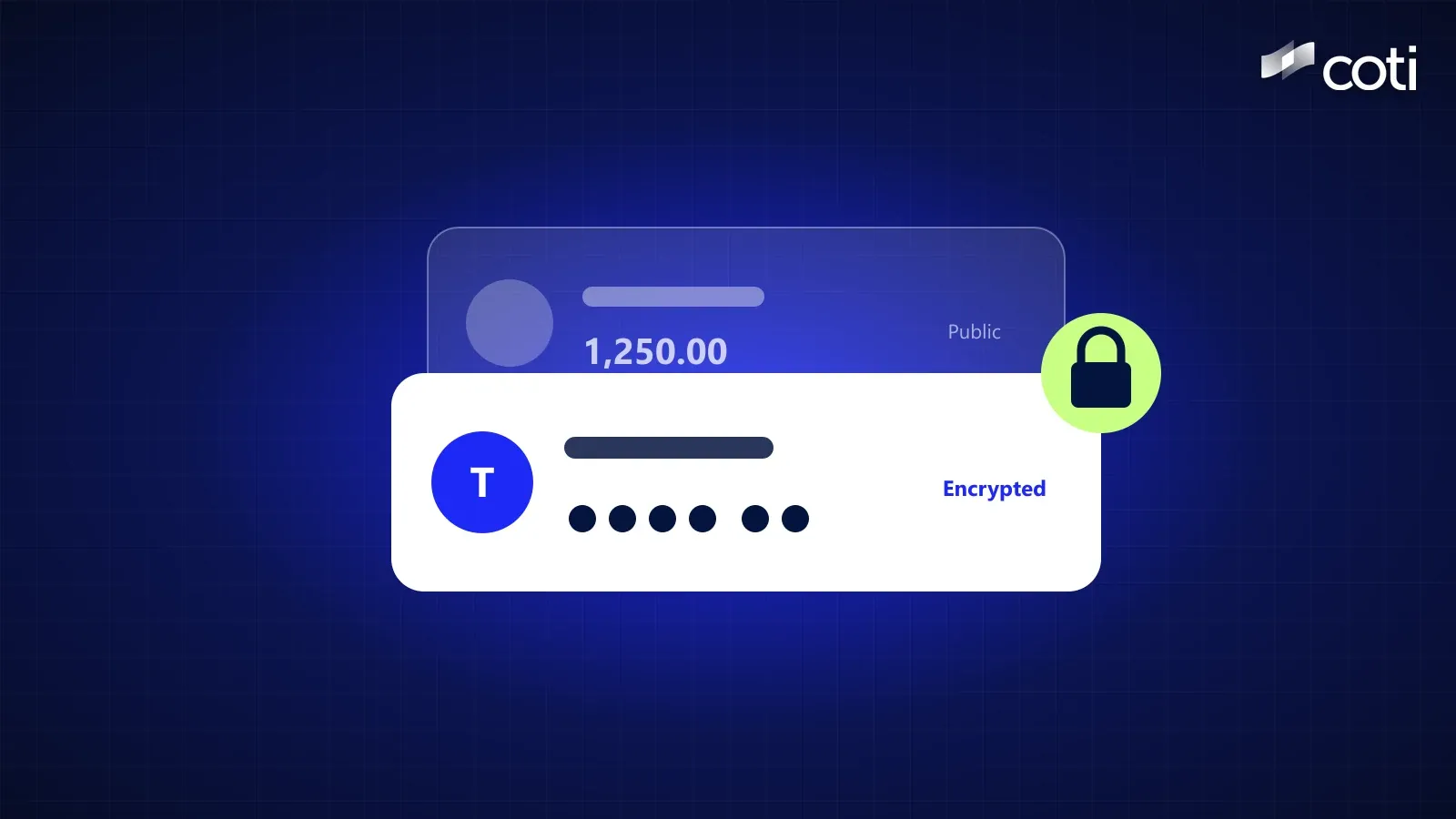
Confidential tokens are tokens whose balances and transfer amounts are encrypted on-chain, so anyone can see that a transfer happened between two addresses but not how much moved. This guide compares three designs: Ethereum's draft ERC-7984 standard, best known through Zama's implementation on fully homomorphic encryption, Solana's confidential transfer extension, built on encryption and zero-knowledge proofs, and COTI's private ERC-20, built on garbled circuits. It explains how each one works, what stays visible, what changes for wallets and apps, and where each stands.
Current as of October 12, 2026.
The Short Answer
What confidential tokens hide
- Balances and transfer amounts, from everyone except the holder and anyone they or the design allow to see them
What they don't hide
- Sender and recipient addresses
- The fact that a transfer happened, and when
- Usually, the amount you move in or out of the confidential form
The three main designs
- Ethereum: ERC-7984, a draft standard, with Zama's implementation live on mainnet
- Solana: the Token-2022 confidential transfer extension, enabled on mainnet according to Solana's docs
- COTI: private ERC-20 tokens, live on COTI's mainnet according to COTI, as of October 12, 2026
What a Confidential Token Hides, and What It Doesn't
A normal token publishes every balance and every transfer amount. A confidential token keeps the same structure (accounts, transfers, a token contract) but stores the numbers encrypted.
What it doesn't change is who is involved. Solana's documentation puts it in one line: "Token account addresses remain public." The same holds for ERC-7984, whose transfer events name the addresses involved, and for COTI's private tokens, whose transfer events show the sender and receiver. Moving tokens into confidential form is also usually a visible step, which our guide to stablecoin privacy covers for USDC.
That makes confidential tokens different from tools that hide who is paid, such as stealth addresses. Confidential tokens hide how much. Stealth addresses hide which known wallet is being paid.
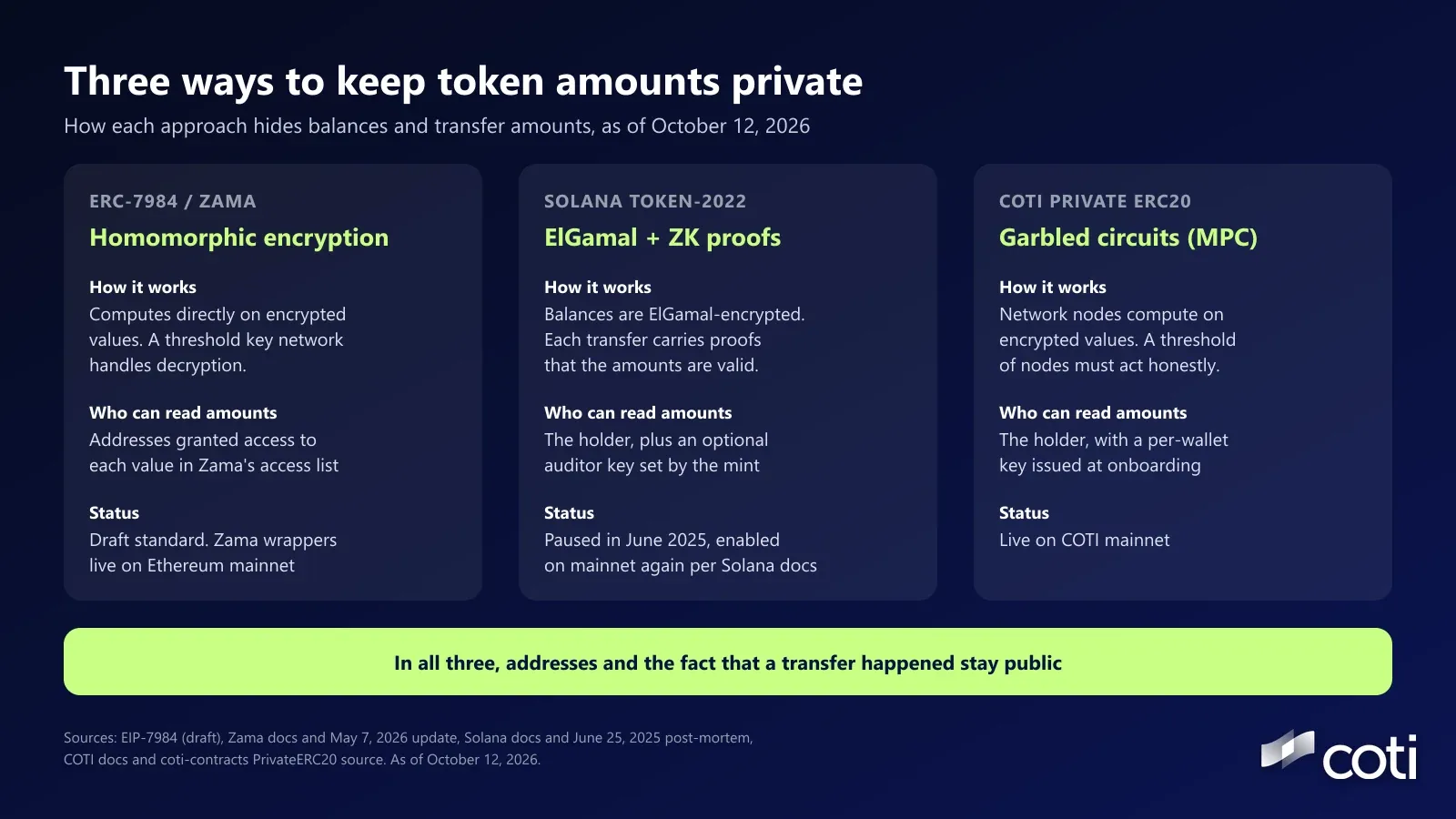
Approach 1: ERC-7984 and Fully Homomorphic Encryption
ERC-7984 is a draft Ethereum standard, created on July 3, 2025. Its abstract opens: "The following standard describes confidential fungible tokens via pointers." In practice:
- Balances and amounts are pointers. Each one is a 32-byte handle that points to an encrypted value. How a handle is resolved is left to the implementation.
- Operators replace allowances. Instead of approving a set amount, a holder can authorise an operator until a set time.
- Disclosure is defined, not designed. The standard includes an event for when an amount is made public, but how that disclosure happens is up to each implementation.
- Security depends on the implementation. The standard's own security section says so, and warns about side-channel attacks and key management.
Zama's implementation. ERC-7984 was co-authored by engineers from OpenZeppelin and Zama, among others, according to OpenZeppelin. Zama runs it on fully homomorphic encryption (FHE), which can compute on encrypted data directly. According to Zama's documentation, contracts on the host chain work with handles, separate coprocessors perform the encrypted computation, and a threshold key management network handles decryption. An access control list decides which addresses can decrypt each value. Zama's protocol went live on Ethereum mainnet at the end of December 2025, and in a May 7, 2026 update, Zama said its official ERC-7984 token wrappers were live on mainnet and testnet.
OpenZeppelin's confidential contracts documentation notes two practical points: the token is not ERC-20 compliant, and an operator can move all of a holder's tokens until the authorisation expires.
Approach 2: Solana's Confidential Transfers
Solana's Token-2022 program has a confidential transfer extension. Each account holds encrypted balances, and every transfer carries zero-knowledge proofs that the encrypted amounts are valid, so the network can check them without seeing them.
- How a transfer works: value moves from the sender's encrypted available balance to the recipient's encrypted pending balance, and the recipient then applies it to their available balance.
- Who can read amounts: the holder, with their own keys. A token's issuer can also set an optional auditor key, which can read transfer amounts but cannot move funds.
- Status: Solana disabled the ZK ElGamal Proof program, which checks these proofs, on June 19, 2025 after a bug that could let an attacker forge a valid-looking proof was reported, according to its post-mortem. It said the program would be re-enabled after audits. Solana's documentation now says the program is enabled on mainnet and devnet, as of October 12, 2026.
Approach 3: COTI's Private ERC-20 and Garbled Circuits
COTI's private ERC-20 is live on COTI's own mainnet, where COTI says its garbled-circuit network has run in production since March 2025 (COTI, September 1, 2026). Instead of homomorphic encryption or proofs, a set of network nodes computes on encrypted values using garbled circuits, explained in our garbled circuits guide.
According to COTI's developer guide:
- Balances are stored twice, both encrypted: one copy under the network's key, used for computation, and one under the holder's own key, so the holder can read it.
- Amounts are hidden when sent encrypted. The private transfer functions take the amount as an encrypted value with a signature, turn it into a temporary form for the computation, and store the result encrypted. The contract also has plain-number versions of transfer, approve, mint and burn, and with those the amount is visible in the transaction, so wallets and apps need to use the encrypted versions. COTI's private data types documentation says the temporary values are deleted once the transaction completes.
- Reading your balance needs onboarding. Each wallet registers once to receive its own encryption key, and the balance is decrypted locally, for MetaMask users often inside COTI's Snap.
- Allowances are encrypted too, and total supply isn't published. The public totalSupply function returns 0, while the real supply is stored encrypted. The contract source warns against plugging the token into protocols that expect the standard ERC-20 total supply.
What you trust. COTI's documentation says the network depends on a threshold of its nodes operating faithfully. The contract source adds that integrators explicitly trust the network's consensus, node and precompile implementation, and upgrade policy. COTI's roadmap lists independent audits as planned for Q4 2026 to Q1 2027 and decentralised nodes as planned for Q4 2027 to Q1 2028, as of October 12, 2026.
Two details to know
- Versions: the current contract on COTI's GitHub is a 256-bit version, while COTI's contracts library page still documents a 64-bit version, as of October 12, 2026.
- ERC-7984: COTI's code repository includes an ERC-7984 compatibility layer for its Privacy-on-Demand tokens, so explorers can recognise them. Its notes describe it as explorer compatibility, not equivalence with Zama's design, say the ERC-7984 transfer functions are disabled in favour of COTI's own, and say the tokens deployed on Ethereum's Sepolia test network don't include it yet, as of October 12, 2026.
What Changes for Wallets, Explorers and Apps
Wallets can't simply read a number. Each design needs the holder's keys to show a balance: Zama decrypts through its key network, Solana uses keys held by the account owner, and COTI uses a per-wallet key, often through its MetaMask Snap.
Explorers show that a transfer happened and between which addresses, with the amount encrypted.
Apps and DeFi need changes. ERC-7984 tokens aren't ERC-20 compliant, per OpenZeppelin, and an ERC-7984 operator can move any amount until its authorisation expires. COTI's private ERC-20 doesn't publish total supply, and its plain-number functions reveal amounts. Apps built for ordinary tokens won't automatically work with confidential ones.
Oversight varies by design. Solana has an optional auditor key, and OpenZeppelin's ERC-7984 library includes an observer extension that gives a chosen address access to an account's amounts. COTI says its Privacy-on-Demand stack, live on Avalanche since September 2026, includes the option to define selective disclosures for compliance (September 16, 2026), but hasn't documented how that works for private ERC-20 tokens. Read-only sharing for accountants is planned for Q2 to Q3 2027 on COTI's roadmap, as of October 12, 2026.
Other Projects Worth Knowing
- Stellar: confidential tokens are a developer preview, live on testnet with unaudited contracts, and Stellar's announcement describes a designated auditor role that can view amounts and balances, as of October 12, 2026.
- Circle: Circle and Inco published a confidential ERC-20 research framework in October 2024, which Circle said does not mean it is turning the framework into a product.
Frequently Asked Questions
Is ERC-7984 a final standard?
No. As of October 12, 2026, ERC-7984 is listed as a draft on the Ethereum Improvement Proposals site. Implementations exist, but the specification can still change.
Are confidential tokens the same as privacy coins?
No. A confidential token is a token on a public network with its balances and amounts encrypted, while addresses stay public. A privacy coin is a separate cryptocurrency with privacy built into its own protocol, often including the parties.
Can I use a confidential token in any wallet or app?
Not automatically. Reading an encrypted balance needs the holder's keys and software that supports the design, and many apps rely on standard token behaviour, such as a public total supply, that confidential tokens change.
Where to Go From Here
Our take: confidential tokens are a practical way to keep amounts private on public networks today, as long as you remember that addresses and activity stay visible. If you build on COTI, the private ERC-20 developer guide walks through deploying and reading private tokens, including onboarding.
Details checked October 12, 2026. Standards and product status can change. Nothing here is financial or legal advice. Zama, Solana, OpenZeppelin, Stellar, Circle and Inco are not affiliated with COTI. COTI will never ask for your seed phrase or private key, and only coti.io, docs.coti.io and COTI's official X and Telegram carry announcements.
Sources
- ERC-7984: Confidential Fungible Token, Ethereum Improvement Proposals, created July 3, 2025, accessed October 12, 2026
- Privacy, OpenZeppelin, accessed October 12, 2026
- ERC7984ObserverAccess.sol, OpenZeppelin on GitHub, accessed October 12, 2026
- Confidential contracts: token, OpenZeppelin, accessed October 12, 2026
- Zama Protocol overview, Zama, accessed October 12, 2026
- The Zama Protocol is on mainnet, Zama community forum, published December 30, 2025, accessed October 12, 2026
- Zama Protocol update: new SDK, delegated decryption, developer tooling and protocol apps, Zama, published May 7, 2026, accessed October 12, 2026
- Confidential Transfer extension, Solana documentation, accessed October 12, 2026
- Transfer tokens with Confidential Balances, Solana documentation, accessed October 12, 2026
- Post-mortem, June 25, 2025, Solana, dated June 25, 2025 in its title, accessed October 12, 2026
- PrivateERC20 developer guide, COTI documentation, accessed October 12, 2026
- Private data types, COTI documentation, accessed October 12, 2026
- What is onboarding, COTI documentation, accessed October 12, 2026
- Garbled circuits (advanced topics), COTI documentation, accessed October 12, 2026
- PrivateERC20.sol, coti-io on GitHub, accessed October 12, 2026
- ERC-7984 compatibility notes, coti-io on GitHub, accessed October 12, 2026
- Private ERC20 (contracts library), COTI documentation, accessed October 12, 2026
- Privacy-on-Demand: How Privacy Works Across Chains, COTI, published September 1, 2026, accessed October 12, 2026
- COTI x Avalanche: Privacy Built for Business, COTI, published September 16, 2026, accessed October 12, 2026
- Privacy on Stellar, Stellar developer docs, accessed October 12, 2026
- Developer preview: confidential tokens on Stellar, Stellar, accessed October 12, 2026
- Roadmap, COTI, accessed October 12, 2026
- Confidential ERC-20 Framework for Compliant On-Chain Privacy, Circle, published October 28, 2024, accessed October 12, 2026