A zero-knowledge proof is a way to prove that a statement is true without revealing the information that makes it true. In crypto, zero-knowledge proofs (ZK proofs) let a network check that a transaction or a batch of transactions is valid without re-running it, and in privacy systems, without seeing the private data behind it. They power ZK rollups that scale Ethereum, shielded payments on Zcash and confidential transfers on Solana. They don't hide everything, though. Addresses, timing and other details often stay visible, depending on the design.
Current as of October 19, 2026.
The Short Answer
What a ZK proof does
- Convinces a verifier that a statement is true
- Reveals nothing beyond the fact that it's true
Where crypto uses it
- ZK rollups, to prove batches of transactions were executed correctly
- Shielded payments on Zcash
- Confidential transfers on Solana, to prove encrypted amounts are valid
What it doesn't do on its own
- Hide who is transacting, unless the design adds that
- Come for free: generating proofs takes heavy computation
A Simple Way to Think About It
Imagine proving to a website that you're over 18 without showing your date of birth. A zero-knowledge proof would let the site confirm that you are over 18 and learn nothing else. Ethereum.org's zero-knowledge proofs guide (checked October 19, 2026) puts it this way: "A zero-knowledge proof is a way of proving the validity of a statement without revealing the statement itself." Strictly, the statement itself, such as the claim that a person is over 18, is known to both sides. What stays hidden is the secret behind it, which cryptographers call the witness. In practice the proof is usually about a credential, such as a digital ID signed by an issuer the site trusts.
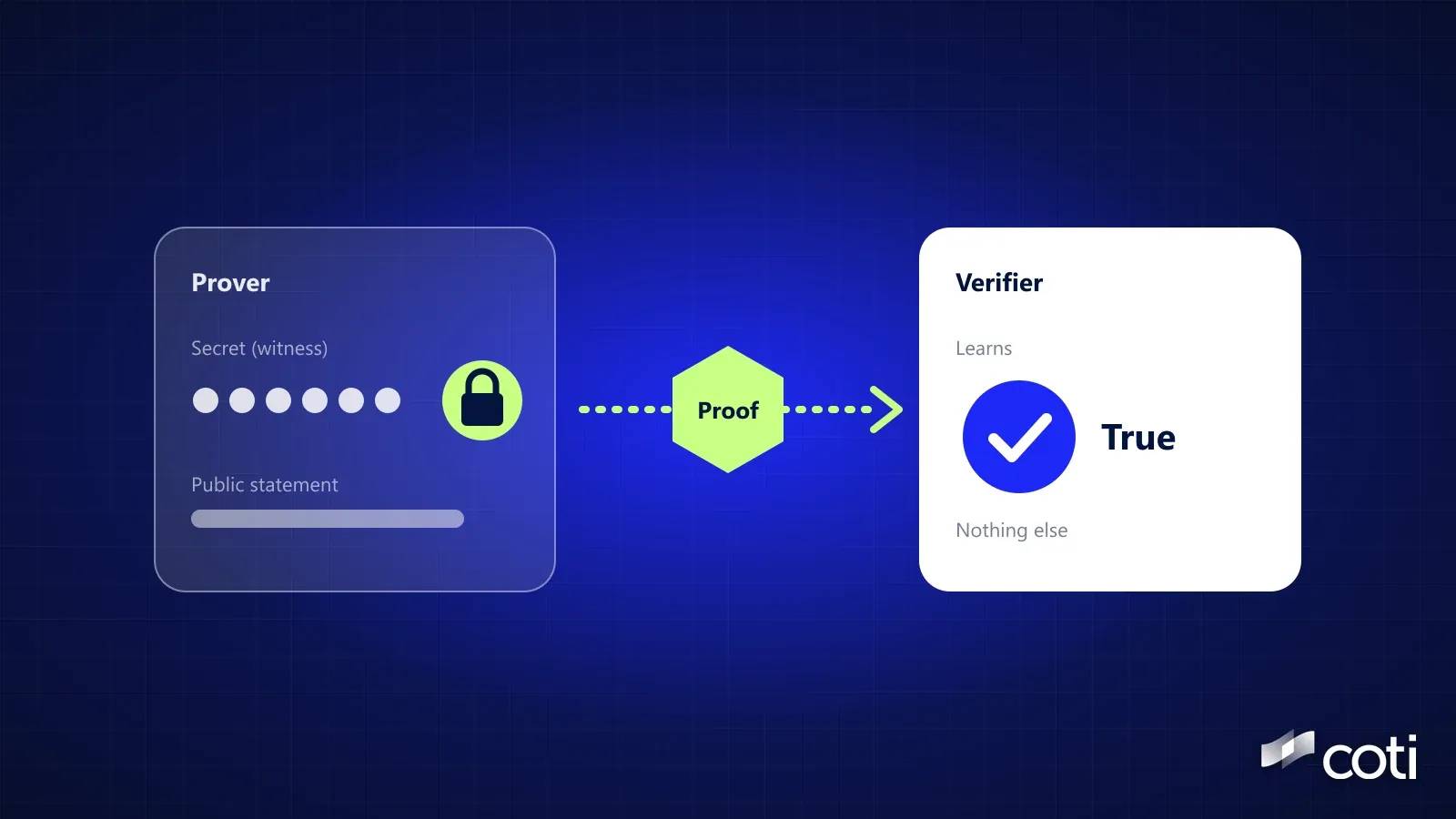
There are always two roles. The prover knows the secret and creates the proof. The verifier checks it.
The Three Properties of a Zero-Knowledge Proof
Ethereum.org lists three properties every ZK proof must have:
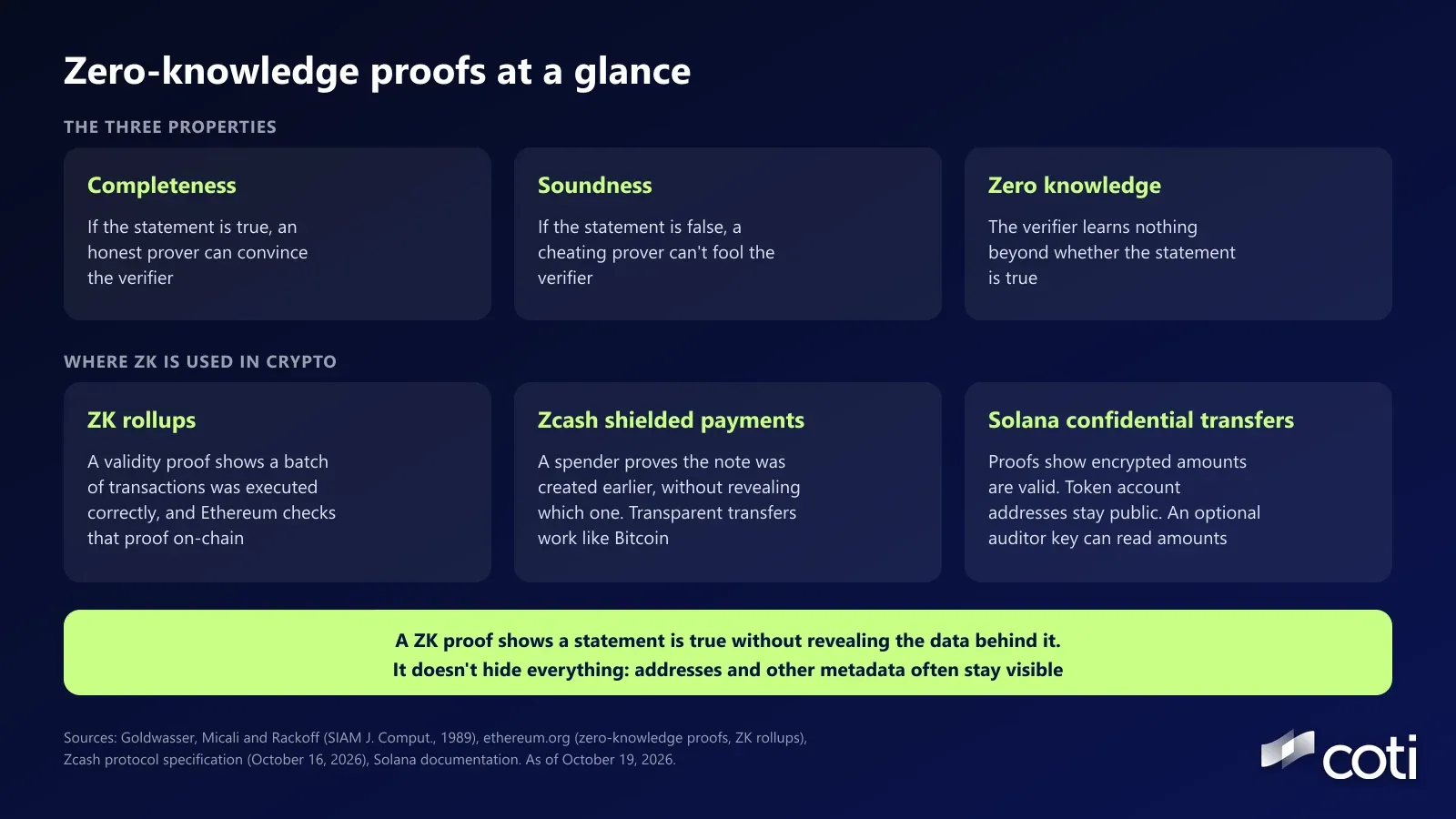
- Completeness: if the input is valid, the protocol always returns true.
- Soundness: if the input is invalid, it's theoretically impossible to fool the protocol into returning true. In practice, cryptographers mean the odds of cheating are negligibly small.
- Zero knowledge: the verifier learns nothing about the statement beyond whether it's valid.
The first two make it a proof. The third makes it zero-knowledge.
Where the Idea Came From
Zero-knowledge proofs were invented by academic cryptographers years before blockchains existed. Shafi Goldwasser, Silvio Micali and Charles Rackoff introduced them in a paper titled The Knowledge Complexity of Interactive Proof Systems, submitted in 1985 and published in the SIAM Journal on Computing in 1989. Their abstract defines them precisely: "Zero-knowledge proofs are defined as those proofs that convey no additional knowledge other than the correctness of the proposition in question."
The first ZK proofs were interactive: prover and verifier exchanged several rounds of messages. Ethereum.org credits Manuel Blum, Paul Feldman and Silvio Micali with the first non-interactive proofs, which need only one round of communication. That's what makes ZK practical for blockchains, where a proof is posted once and anyone can check it.
SNARKs and STARKs
Ethereum.org describes two widely discussed families of ZK proofs. They aren't the only ones: Solana's confidential transfers, covered below, use other proof types (sigma protocols and Bulletproofs) that need no trusted setup, according to Solana's program documentation.
ZK-SNARKs
- Short for zero-knowledge succinct non-interactive argument of knowledge
- Small proofs that are quick to verify
- Many rely on a trusted setup: public parameters generated in advance, which requires trusting the people who generated them. Multi-party setup ceremonies reduce this risk, per ethereum.org
- Ethereum.org notes that SNARKs built on elliptic-curve cryptography could be broken by future quantum computers
ZK-STARKs
- Short for zero-knowledge scalable transparent argument of knowledge
- Transparent: they use publicly verifiable randomness instead of a trusted setup
- Ethereum.org says they're considered immune to the threat of quantum computing, because they rely only on collision-resistant hash functions
- Proofs are larger, which makes them more expensive to verify on Ethereum, per ethereum.org's ZK rollups page
Where Zero-Knowledge Proofs Are Used in Crypto
ZK rollups
ZK rollups are layer 2 networks that move computation off Ethereum's main chain. They post a validity proof that a batch of transactions was executed correctly, and Ethereum checks that proof, according to ethereum.org. Here ZK is used for scaling. Rollups still publish the data needed to rebuild their state, and ethereum.org says validity proofs used for scaling don't, by themselves, make a rollup's transactions confidential.
Zcash shielded payments
Zcash uses zk-SNARKs for its shielded payments. Its protocol specification says that when a note is spent, the spender proves that a commitment to it was published earlier without revealing which one, so the spent note can't be linked to the transaction that created it. Zcash also has transparent transfers, which the specification says have the same privacy properties as Bitcoin. In its Sapling and Orchard designs, a full viewing key lets someone recognise a holder's incoming and outgoing shielded notes without being able to spend them.
Solana confidential transfers
Solana's Token-2022 extension for this, which its documentation now calls Confidential Balances, encrypts balances and transfer amounts. Each transfer carries zero-knowledge proofs that the encrypted amounts are valid. Solana's documentation says token account addresses remain public, and a token's issuer can set an optional auditor key whose holder can decrypt transfer amounts. The proof program behind it was disabled on June 19, 2025 after a bug that could allow forged proofs, according to Solana's post-mortem, and Solana's documentation says it is enabled on mainnet and devnet as of October 19, 2026. Our guide to confidential tokens compares it with other designs.
What Zero-Knowledge Proofs Don't Do
- They don't make everything private. A ZK proof hides the data behind one statement. Depending on the design, addresses, timing and fees can stay visible, as our guide to who can see your crypto wallet explains.
- They're expensive to generate. Ethereum.org notes that generating proofs involves very complex calculations best done on specialised machines.
- Trusted setups add trust. For SNARKs that use one, ethereum.org says there's no way for users to fully assess the honesty of the people who generated the parameters.
- They prove only what they're designed to prove. A proof that a transaction is valid says nothing about who sent it, and a bug can still undermine it, as Solana's 2025 proof-program flaw showed.
ZK, Encryption and Garbled Circuits
ZK proofs are one of several cryptographic tools used for privacy, and they solve a different problem from the others:
- Zero-knowledge proofs prove that a statement about hidden data is true.
- Encryption hides data, and some schemes, such as fully homomorphic encryption, let computers work on encrypted data directly.
- Garbled circuits let two or more parties compute a result from private inputs, with each learning only the result. COTI's network, live in production on its mainnet since March 2025 according to COTI, uses them to run smart contracts on encrypted values. That holds as long as its nodes don't collude, as our guide to garbled circuits explains.
Real systems often combine them. Solana's confidential transfers, for example, use both encryption and ZK proofs.
Frequently Asked Questions
Is a zero-knowledge proof the same as encryption?
No. Encryption hides data so only key holders can read it. A ZK proof convinces someone that a statement about data is true without revealing the data. Many privacy systems use both together.
Do zero-knowledge proofs make crypto transactions private?
Only if the system is designed for it. ZK rollups use proofs for scaling, while Zcash shielded payments and Solana confidential transfers use them for privacy. Even then, some details, such as Solana's account addresses, stay public.
Are zero-knowledge proofs safe against quantum computers?
It depends on the type. Ethereum.org says STARKs are considered immune to quantum attacks because they rely on hash functions, while quantum computers could break the elliptic-curve security model many SNARKs rely on.
Where to Go From Here
Zero-knowledge proofs are one of the most useful ideas in modern cryptography: proof without disclosure. If you build on COTI, whose mainnet uses garbled circuits for computing on encrypted data (live since March 2025, per COTI), start with the Build on COTI documentation.
Details checked October 19, 2026. Standards and implementations can change. Nothing here is financial or legal advice. Ethereum.org, Zcash and Solana are mentioned for reference only and aren't affiliated with COTI. COTI will never ask for your seed phrase or private key, and only COTI's official channels (coti.io, docs.coti.io, COTI's Medium blog and its official X and Telegram) carry announcements.
Sources
- Zero-knowledge proofs, ethereum.org, site updated October 15, 2026, accessed October 19, 2026
- Zero-knowledge rollups, ethereum.org, updated October 7, 2026, accessed October 19, 2026
- The Knowledge Complexity of Interactive Proof Systems, Shafi Goldwasser, Silvio Micali and Charles Rackoff, SIAM Journal on Computing 18(1), pp. 186-208, 1989 (received August 26, 1985), accessed October 19, 2026
- Zcash Protocol Specification, Daira-Emma Hopwood, Sean Bowe, Taylor Hornby and Nathan Wilcox, version v2026.7.0-318-ga34cfc [NU6.2] dated October 16, 2026, accessed October 19, 2026
- Confidential Balances (confidential transfer extension), Solana documentation, accessed October 19, 2026
- Zero-knowledge proofs in Confidential Balances, Solana Program Library documentation, accessed October 19, 2026
- Post-mortem, June 25, 2025, Solana, accessed October 19, 2026
- Privacy-on-Demand: How Privacy Works Across Chains, COTI, published September 1, 2026, accessed October 19, 2026
- Garbled circuits explained, COTI, accessed October 19, 2026
- Build on COTI, COTI documentation, accessed October 19, 2026