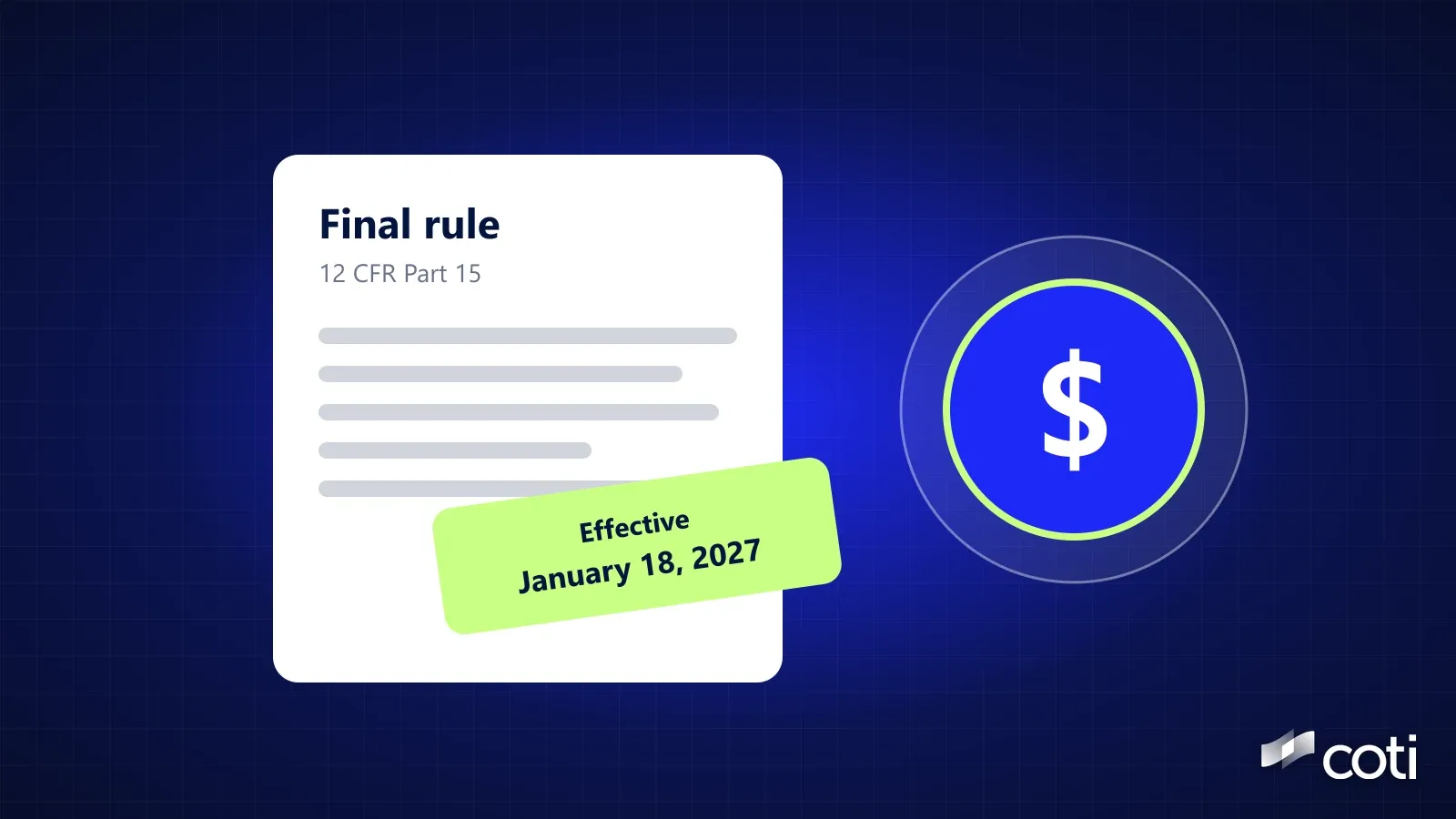
The US Office of the Comptroller of the Currency (OCC) issued its final rule implementing the GENIUS Act on October 21, 2026, setting reserve, redemption, disclosure and custody rules for the stablecoin issuers it supervises, and both the rule and the Act take effect on January 18, 2027, according to the OCC's announcement. For stablecoins from issuers the OCC supervises, it settles what must back the coins and how fast they can be redeemed. The rules on monitoring, freezing and sanctions are in a separate rulemaking that isn't final yet.
Current as of October 22, 2026.
What the OCC Decided
The final rule
- Issued: October 21, 2026 (OCC News Release 2026-92 and Bulletin 2026-50)
- Takes effect: January 18, 2027, the same day as the GENIUS Act
- Who it covers: stablecoin issuers the OCC supervises (including subsidiaries of national banks and federal savings associations, federally approved nonbank issuers and some state-qualified issuers), foreign issuers under its jurisdiction, and certain custody activities
- Where it sits: a new part of US federal banking rules, 12 CFR Part 15
- What's left out: Bank Secrecy Act, anti-money laundering and OFAC sanctions requirements, which the OCC is handling in a separate rulemaking with the US Treasury
- What's next: the OCC will announce separately when it starts accepting applications
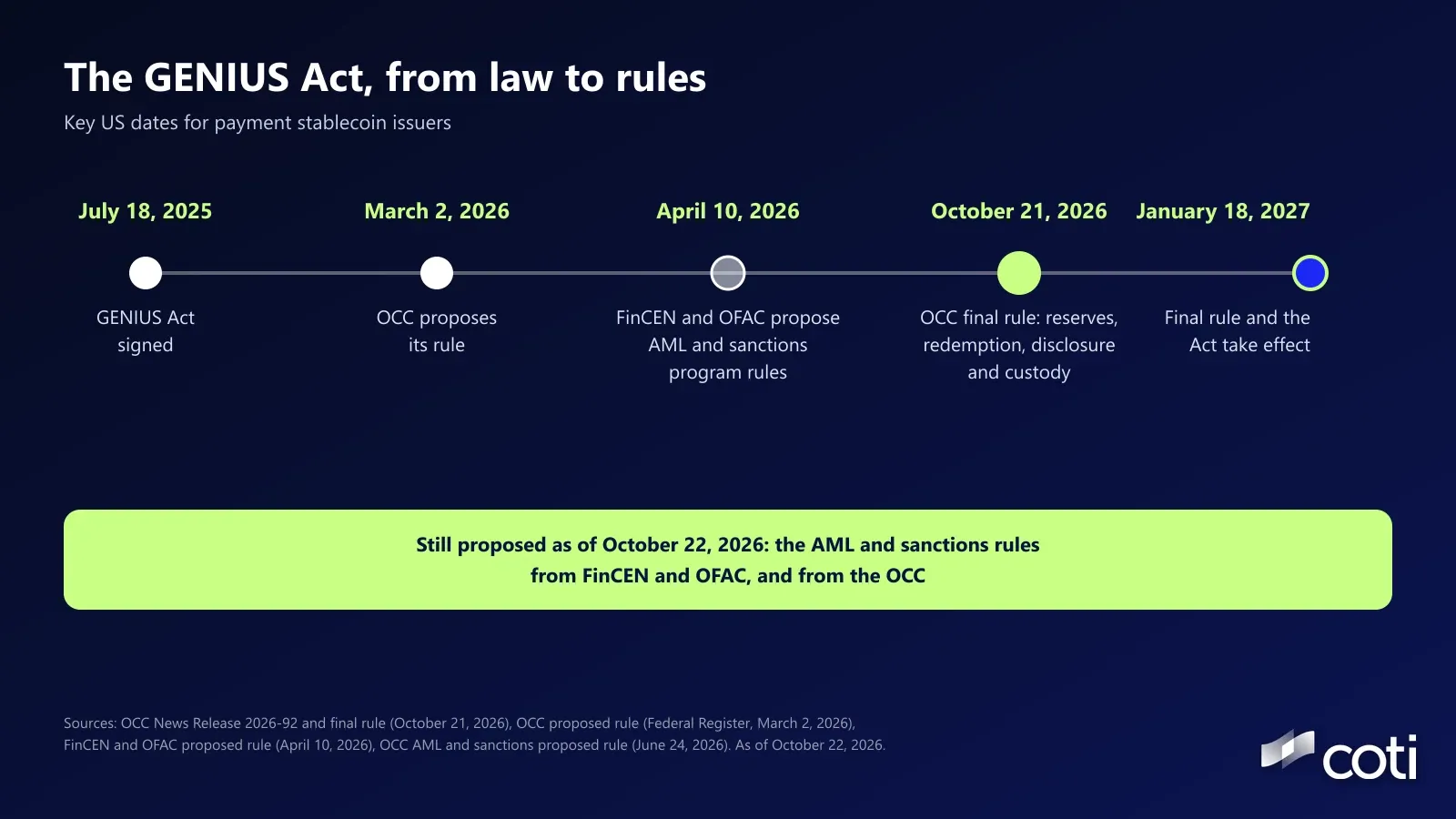
The GENIUS Act, signed on July 18, 2025, is the US federal framework for payment stablecoins. Section numbers below refer to the OCC's final rule text.
What Has to Back the Coins?
Under section 15.11, an issuer's reserves must at all times be worth at least as much as the stablecoins it has issued. They must be identifiable, kept separate from the issuer's other assets, and held by the issuer or by an eligible financial institution. Only listed assets count:
- US currency and balances at the Federal Reserve
- Demand deposits at insured banks and credit unions
- US Treasury bills, notes or bonds with 93 days or less to maturity
- Overnight repurchase agreements backed by Treasuries
- Government money market funds
- Other similarly liquid federal government assets the OCC approves, and tokenized forms of some of these
How Fast Can You Redeem?
Section 15.12 says redemption may take no more than two business days after a request. The two-day clock starts once the customer has been successfully onboarded and other legal conditions are met. The OCC says onboarding must follow anti-money laundering laws, and FinCEN's customer identification rule for issuers is still a proposal. If redemption requests top 10 percent of a stablecoin's outstanding supply within 24 hours, the issuer must tell the OCC within 24 hours and can ask for more time.
What Must Issuers Publish?
By noon on the last day of each month, an issuer must post on its website its reserve composition as of the previous month-end, including the average maturity of its reserves and where they're held. A registered public accounting firm must examine each report, and the chief executive and chief financial officer must certify to the OCC that it's accurate.
Can Issuers Pay Interest?
No. Section 15.10 bars issuers from paying holders any interest or yield solely for holding, using or keeping their stablecoins, mirroring the Act. For arrangements involving third parties, the OCC dropped a presumption it had proposed and chose not to publish a list of allowed or banned setups. It says it will judge each one on its facts and circumstances.
What It Means for Privacy
Self-custody wallets aren't banned. The OCC's explanation of the rule says plainly: "The Act does not specifically prohibit self-custody or non-hosted wallets." It declines to bar issuers from using them, but says that use must still comply with the Act and other laws, including the Act's lawful-order requirement and anti-money laundering and sanctions rules.
Freezing is in the law, not in this rule. From January 18, 2027, the Act requires an issuer to be able to comply with lawful orders to seize, freeze, burn or stop the transfer of specific coins, as our stablecoin privacy guide explains. The OCC's final rule doesn't define freeze or seize and declines to mandate particular technical requirements. The OCC says it may consider defining those terms if its forthcoming anti-money laundering and sanctions rule uses them.
The monitoring rules are still proposals. FinCEN and OFAC proposed anti-money laundering and sanctions program rules for issuers on April 10, 2026. The proposal covers anti-money laundering programs, customer due diligence, suspicious activity reporting and the technical ability to block, freeze and reject transactions. FinCEN says the blocking and lawful-order duties would reach secondary market activity too, meaning transfers between holders after issuance, but it isn't proposing that issuers monitor, or file suspicious activity reports on, those transactions. Customer identification is in a separate FinCEN proposal published June 22, 2026, and the OCC published its own anti-money laundering and sanctions proposal on June 24, 2026. We found no final version of any of them in the Federal Register as of October 22, 2026.
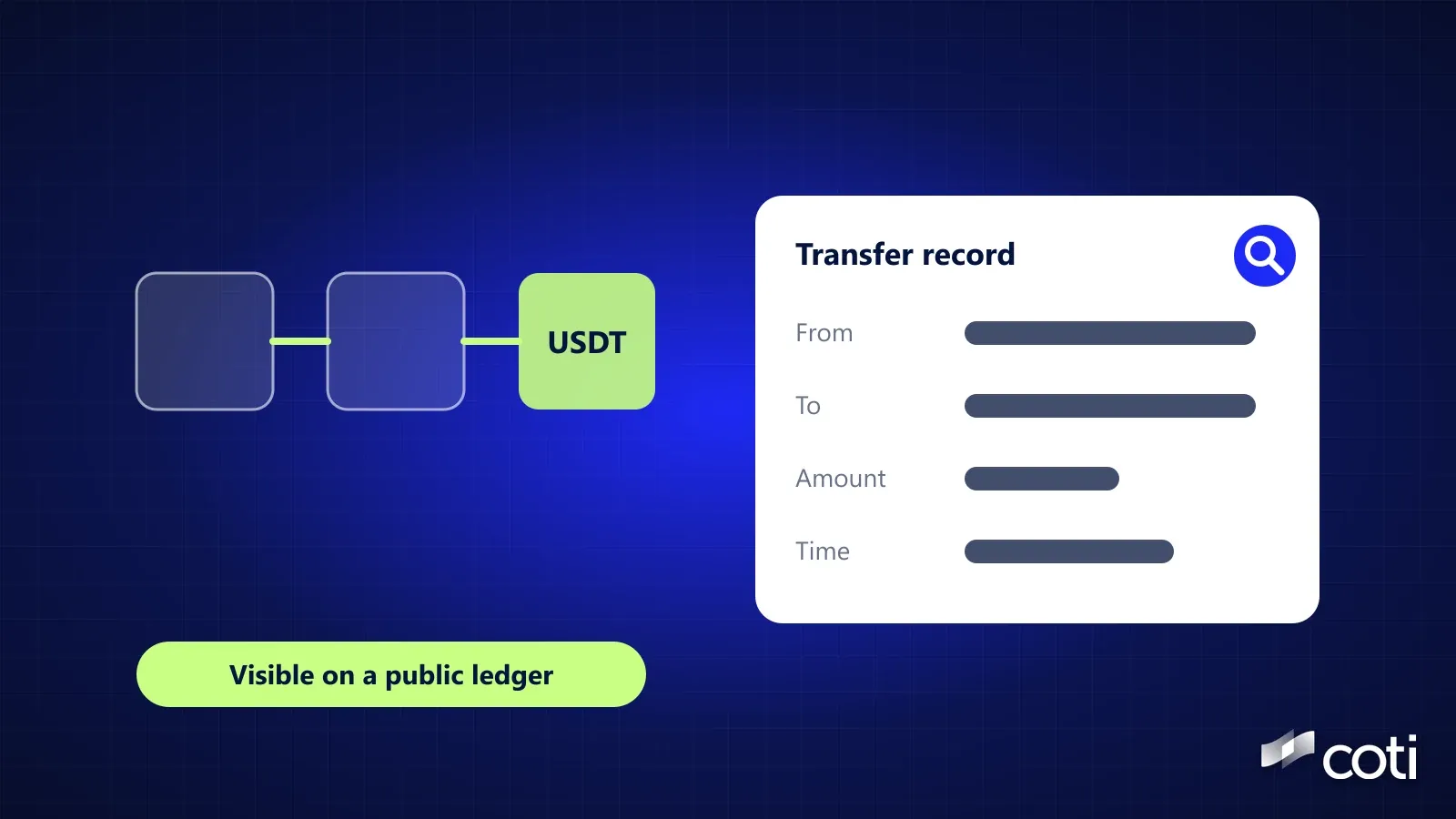
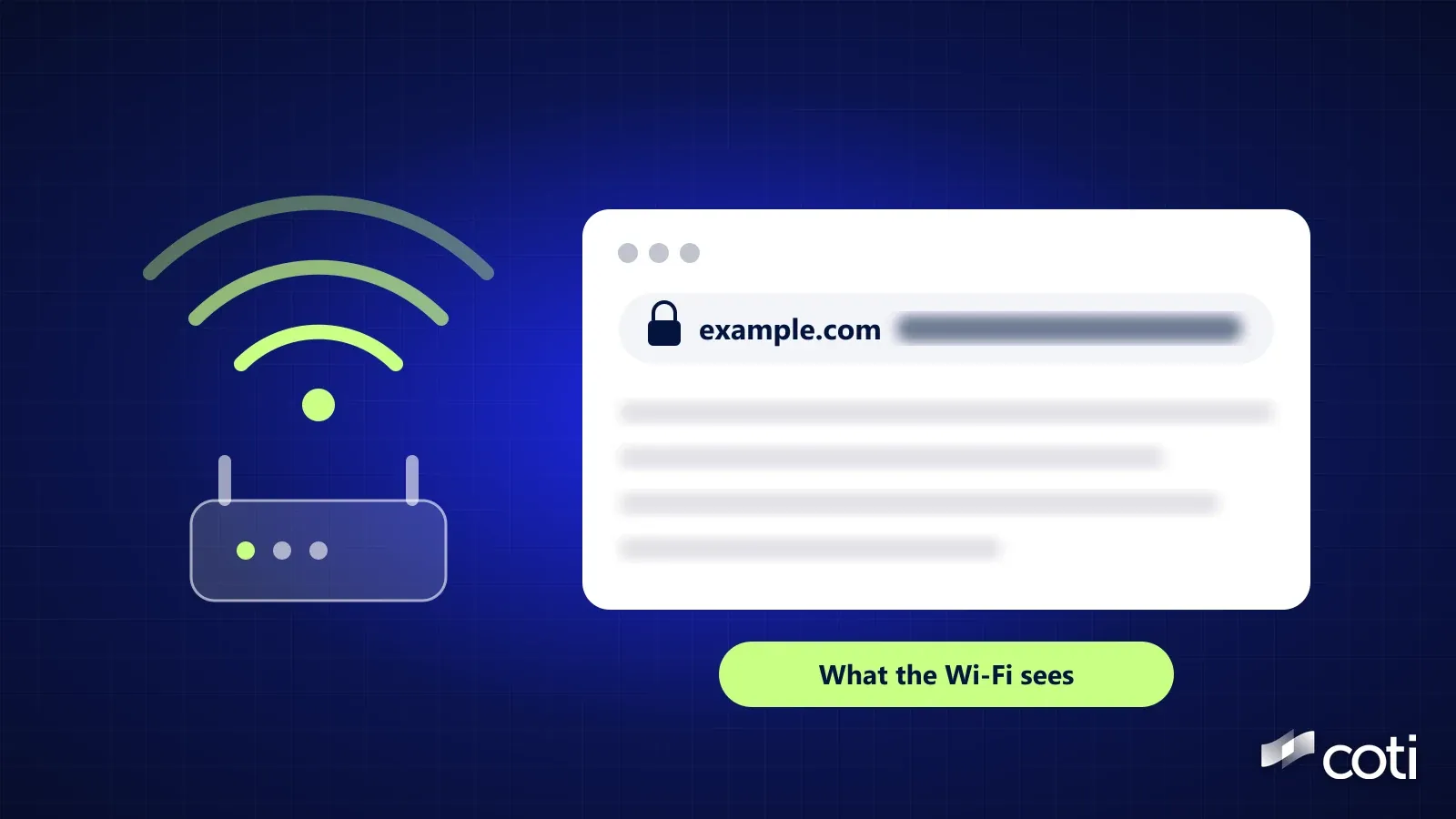
Holding and redeeming are different. A stablecoin can move between wallets on a public chain without the issuer onboarding each holder, but redeeming it with a regulated issuer for dollars means being onboarded by that issuer. What anyone can see of the transfers themselves depends on the chain, as our guide to whether anyone can see your crypto wallet explains.
What It Means for COTI Users
This rule's requirements are written for stablecoin issuers and for certain custody activities of OCC-supervised firms. We don't assess how the rule or the Act applies to any particular product, including COTI's.
The rule doesn't change how COTI's privacy tools work. COTI says its Privacy Portal has been live on Avalanche C-Chain with private AVAX and USDC since September 2026. COTI's explainer on its Privacy-on-Demand technology says it encrypts values such as amounts, not the fact that a transaction happened, which stays visible on the public chain. COTI's documentation doesn't describe how issuer freezes apply to stablecoins used through the Portal, as of October 22, 2026.
Frequently Asked Questions
When does the GENIUS Act take effect?
The OCC says its final rule and the Act take effect on January 18, 2027. The OCC will announce separately when it starts accepting issuer applications.
Does the GENIUS Act final rule apply to every stablecoin?
This rule covers issuers under the OCC's jurisdiction and certain custody activities of banks it supervises. Other regulators, including the Federal Reserve, FDIC, NCUA and the US Treasury, have their own GENIUS Act rules in progress. Most were still proposals as of October 22, 2026. One exception is a US Treasury interim final rule on how state certifications are reviewed, in effect since September 30, 2026.
Can stablecoin issuers still freeze tokens?
Yes. From January 18, 2027, the Act will require issuers to be able to comply with lawful orders to freeze or seize specific coins, and FinCEN's proposal notes that some issuers already block or freeze tokens through their smart contracts. Our stablecoin privacy guide covers the major issuers' own freeze terms. This OCC rule doesn't add technical requirements, and the detailed anti-money laundering and sanctions rules are still proposals.
Where to Go From Here
The reserve and redemption rules are now set, and the rules on monitoring and freezing are the ones to watch next. For who can see and freeze a stablecoin payment today, read our stablecoin privacy guide. To see how COTI's private tokens keep amounts encrypted, start with the Privacy Portal documentation.
Details checked October 22, 2026. Rules and dates can change. Nothing here is financial or legal advice. COTI will never ask for your seed phrase or private key, and only COTI's official channels (coti.io, docs.coti.io, COTI's Medium blog and its official X and Telegram) carry announcements.
Sources
- OCC Advances U.S. Digital Asset Leadership with Final Rule to Implement GENIUS Act, OCC News Release 2026-92, published October 21, 2026, accessed October 22, 2026
- GENIUS Act Regulations: Final Rule, OCC Bulletin 2026-50, published October 21, 2026, accessed October 22, 2026
- Final rule text: Implementing the GENIUS Act for the Issuance of Stablecoins by Entities Subject to the Jurisdiction of the OCC, OCC, published October 21, 2026, accessed October 22, 2026
- GENIUS Act, Public Law 119-27, US Government Publishing Office, enacted July 18, 2025, accessed October 22, 2026
- Permitted Payment Stablecoin Issuer AML/CFT Program and Sanctions Compliance Program Requirements (proposed rule), FinCEN and OFAC, Federal Register, published April 10, 2026, accessed October 22, 2026
- Permitted Payment Stablecoin Issuer Customer Identification Program (proposed rule), FinCEN, Federal Register, published June 22, 2026, accessed October 22, 2026
- Permitted Payment Stablecoin Issuer AML/CFT and Sanctions Compliance Risk Management (proposed rule), OCC, Federal Register, published June 24, 2026, accessed October 22, 2026
- Forms and Procedures for Review of State Certifications by the Stablecoin Certification Review Committee (interim final rule), US Department of the Treasury, Federal Register, published September 30, 2026, accessed October 22, 2026
- COTI Privacy Portal, COTI documentation, accessed October 22, 2026
- Privacy-on-Demand: How Privacy Works Across Chains, COTI, published September 1, 2026, accessed October 22, 2026
- COTI x Avalanche: Privacy Built for Business, COTI, published September 16, 2026, accessed October 22, 2026