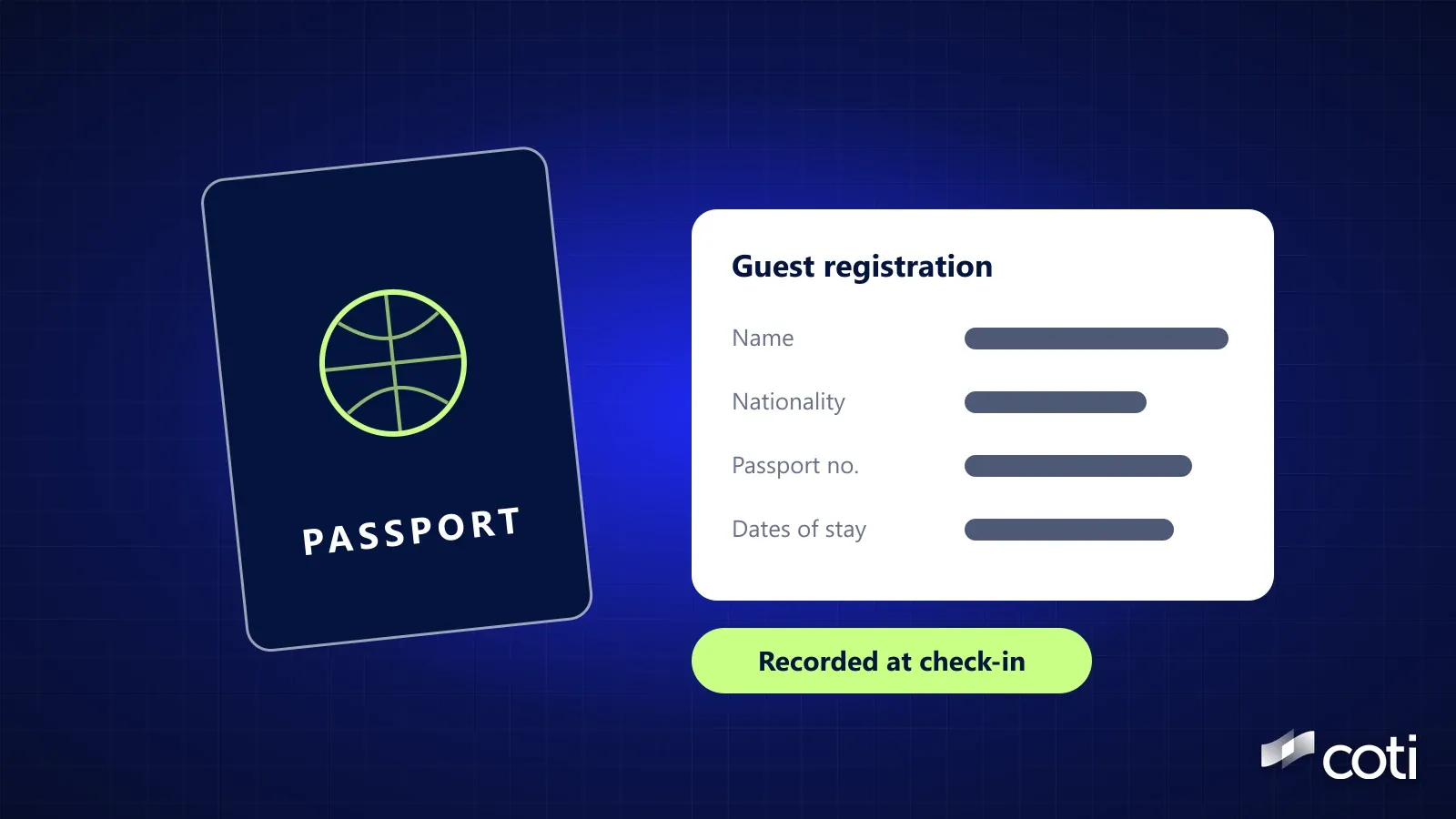
Why do hotels take your passport? In many countries, including the Schengen area, the UK and Japan, the law requires hotels to record guests' identity details at check-in, often including the passport number. Hotels keep those records for the authorities, and in Italy and Spain send them to the police within 24 hours. The rules ask for your details, not for the hotel to hold your passport. On copies they differ: Spain's and Italy's data-protection authorities have told hotels not to keep them, while Japan's health ministry asks hotels to keep a copy of foreign visitors' passports. Here's what hotels record, who can see it and how long they keep it, with the actual rules for six countries.
Current as of October 26, 2026. Rules differ by country and can change.
The Short Answer
Why they ask
- A legal registration duty for guests, especially foreign guests, in many countries
- To confirm that you are who you say you are
What they record
- Your name, nationality and passport number, and dates of stay. Some countries add your address, date of birth, contact details, next destination or, in Spain, how you paid
Who can see it
- The hotel, and the police or other authorities. In Italy and Spain, hotels send the details automatically within 24 hours. Elsewhere, authorities can ask to see them
How long it's kept
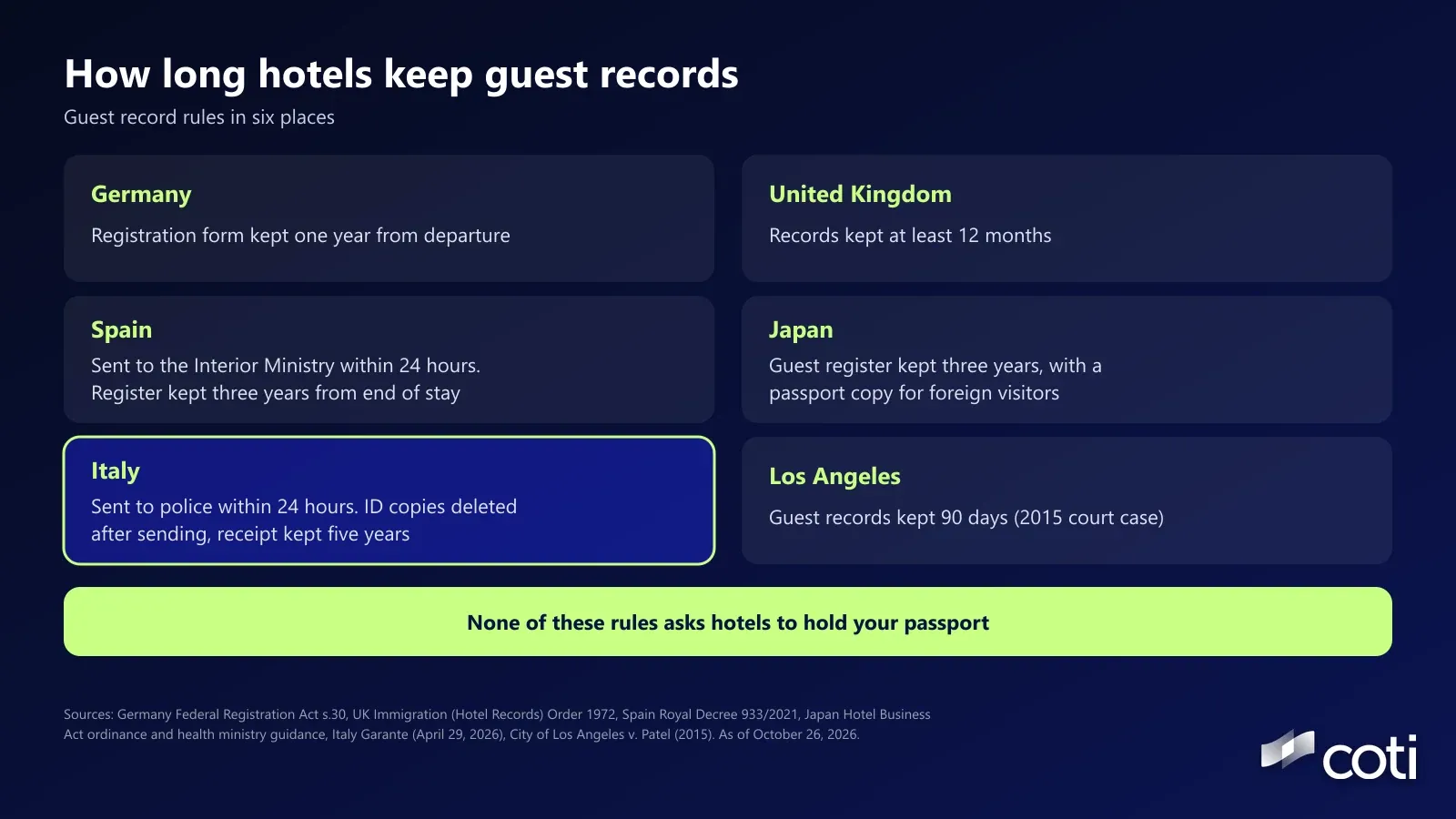
- From 90 days in Los Angeles to three years in Spain and Japan, in the rules covered here. In Italy, hotels send the details to the police and keep only the portal receipt, for five years
The Rule Behind It in Europe
The Schengen countries agreed on this in Article 45 of the Convention implementing the Schengen Agreement. It requires hotels to make sure foreign guests, including citizens of other EU countries, "personally complete and sign registration forms and confirm their identity by producing a valid identity document". Accompanying spouses, accompanying minors and members of travel groups don't have to fill in their own form.
The forms are kept for the authorities, or sent to them where they consider it necessary to prevent threats, for criminal investigations or to trace missing people and accident victims, unless national law says otherwise. The same rule covers any commercially rented accommodation, including tents, caravans and boats. Each country writes its own law to carry this out, which is why the details differ.
The Rules in Six Countries
Germany
- Law: Federal Registration Act, Section 29 and Section 30
- Foreign guests sign a special registration form on arrival and show a valid passport or equivalent document
- The form may contain only set details, including dates of stay, name, date of birth, nationality, address and the passport's serial number
- Kept for one year from departure, then destroyed within three months. Designated authorities can demand the forms
Italy
- Law: Article 109 of the public security code, explained on the Polizia di Stato's pages
- Hosts must send guests' details to the police through the Alloggiati Web portal within 24 hours of arrival, or within 6 hours for shorter stays. Hosts may only accommodate guests who have an identity document, children included
- Italy's data-protection authority, the Garante, said on April 29, 2026 that once the details have been sent to the police, any copies of identity documents collected for this must be deleted or destroyed immediately. Only the portal's receipt may be kept, for five years
Spain
- Law: Royal Decree 933/2021
- Applies to every guest, Spanish or foreign, and every guest over 14 signs the entry form
- Accommodation providers keep a digital register of guest details, including the identity document's type and number, contact details and how you paid (for a card, its type and number)
- They send these details to the Interior Ministry's systems within 24 hours
- Kept for three years from the end of the stay
- Spain's data-protection authority, the AEPD, said on June 17, 2025 that this duty doesn't authorise asking for a copy of your ID, and that a visual check of the document is enough in person
United Kingdom
- Law: Immigration (Hotel Records) Order 1972
- Every guest aged 16 or over gives their full name and nationality. Guests who are aliens under the order (broadly, anyone who isn't a British, Commonwealth or Irish citizen, per a 1982 amendment) also give their passport number and place of issue, and their next destination
- Records are kept for at least 12 months and are open to inspection by the police and Home Office officials
Japan
- Law: the Hotel Business Act and its enforcement ordinance
- Hotels keep a guest register with name, address and contact details. For foreign guests without an address in Japan, it also records nationality and passport number
- The register is kept for three years from when it's made
- Health ministry guidance also asks hotels to see the passport of these guests and keep a copy with the register
United States (Los Angeles example)
- We found no federal rule requiring US hotels to record passports. Guest-register rules there come from cities, counties and some states
- Los Angeles required hotels to keep guest records for 90 days. In City of Los Angeles v. Patel, decided June 22, 2015, the Supreme Court struck down the part that let police inspect those records without first giving hotels a chance at precompliance review by a neutral decision-maker. The record-keeping itself wasn't the issue
Can a Hotel Copy or Scan Your Passport?
It depends on the country. In Spain and Italy, the data-protection authorities say the registration duty isn't a reason to keep a copy. The AEPD's note explains why: an ID document carries more than the law asks for, such as your photo, and processing that extra data raises the risk of identity theft. Japan goes the other way: its health ministry guidance asks hotels to keep a copy of foreign visitors' passports with the register. Germany's and the UK's rules don't address copies.
Hotel chains describe their own practice in their privacy notices. Hilton's Global Privacy Statement, last updated August 31, 2026, says it collects national ID or passport information at check-in "as necessary to comply with our legal obligations" and keeps personal information for as long as that purpose requires, plus any period the law requires or allows. If a hotel scans your passport, it's reasonable to ask why, and how long the scan is kept.
Can a Hotel Keep Your Passport?
In the six places covered here, the rules ask for details from your ID, and in some places a look at the document or a copy, but none asks the hotel to hold on to your passport. Practice elsewhere can differ, so if a hotel wants to keep it during your stay, ask what it needs to record and when you'll get it back.
Why It Matters: Hotel Data Breaches
Hotel guest records are a target. The US Federal Trade Commission said in October 2024 that data breaches at Marriott and Starwood affected more than 344 million customers worldwide, and that one of them exposed 5.25 million unencrypted passport numbers. Under the order the FTC announced, the companies must keep personal information only as long as reasonably necessary and let US customers request deletion. Our take: that's the practical case for the regulators' line on copies in Spain and Italy. Copies that aren't kept can't leak.
Where COTI Fits
COTI's roadmap lists private travel booking for Q2 to Q3 2027, as of October 26, 2026, with the goal that the merchant sees a paid receipt and no access to your personal wallet. It isn't live. That's about how you pay, and paying by card leaves its own trail: your bank sees the hotel's name and the amount, as our guide to whether your bank can see what you buy explains. A private booking wouldn't change check-in: hotels would still have to register guests under the laws above. Our guide to booking travel with crypto covers what changes and what doesn't when you pay that way.
Frequently Asked Questions
Why do hotels need your passport number?
Because the registration rules in many countries list it among the details hotels must record for foreign guests, as in Germany, the UK and Japan.
Do hotels in Europe keep a copy of your passport?
It depends on the country and the hotel. Spain's and Italy's data-protection authorities say the registration duty doesn't justify keeping a copy, and in Italy any copies made for it must be destroyed once the details have been sent to the police.
Is it safe to give a hotel my passport?
Showing it is normal and often required by law. Copies depend on the country: Spain's and Italy's regulators say the duty doesn't justify keeping one, while Japan's health ministry asks hotels to copy foreign visitors' passports. If a hotel scans yours, you can ask why and how long it's kept.
Why do hotels in Japan ask for your passport?
Japan's hotel rules require the guest register to include the nationality and passport number of foreign guests who don't live in Japan, and health ministry guidance asks hotels to keep a copy of the passport. The register is kept for three years.
Where to Go From Here
Hotels record your passport details because the law tells them to, and the details travel further than the front desk. Knowing the rules where you're staying tells you what's normal and what isn't. To follow COTI's plans for private travel booking, planned for Q2 to Q3 2027 as of October 26, 2026, see COTI's roadmap. For more on what travel and payments reveal, our guide to spending crypto privately walks through each party.
Details checked October 26, 2026. Laws and hotel policies change, and this isn't a full list of countries. Hilton and Marriott are cited for reference only and aren't affiliated with COTI. Nothing here is financial or legal advice. COTI will never ask for your seed phrase or private key, and only COTI's official channels (coti.io, docs.coti.io, COTI's Medium blog and its official X and Telegram) carry announcements.
Sources
- Convention implementing the Schengen Agreement, Official Journal of the European Communities L 239, published September 22, 2000, accessed October 26, 2026
- Federal Registration Act (Bundesmeldegesetz), Section 29, German Federal Ministry of Justice, accessed October 26, 2026
- Federal Registration Act (Bundesmeldegesetz), Section 30, German Federal Ministry of Justice, accessed October 26, 2026
- Alloggiati Web guidance, Questura di Brescia, Polizia di Stato, accessed October 26, 2026
- Note on guest identity documents, Garante per la protezione dei dati personali, published April 29, 2026, accessed October 26, 2026
- Real Decreto 933/2021, Boletín Oficial del Estado, published October 27, 2021, accessed October 26, 2026
- AEPD: copies of ID cards or passports may not be requested at accommodation, Agencia Española de Protección de Datos, published June 17, 2025, accessed October 26, 2026
- Immigration (Hotel Records) Order 1972, legislation.gov.uk, accessed October 26, 2026
- Immigration (Hotel Records) (Amendment) Order 1982, legislation.gov.uk, accessed October 26, 2026
- Hotel Business Act enforcement ordinance, e-Gov Japan, accessed October 26, 2026
- Answer on keeping passport copies with the guest register, Ministry of Health, Labour and Welfare, accessed October 26, 2026
- City of Los Angeles v. Patel, 576 U.S. 409, US Supreme Court via Cornell Legal Information Institute, decided June 22, 2015, accessed October 26, 2026
- FTC takes action against Marriott and Starwood over multiple data breaches, Federal Trade Commission, published October 9, 2024, accessed October 26, 2026
- Global Privacy Statement, Hilton, last updated August 31, 2026, accessed October 26, 2026
- Roadmap, COTI, accessed October 26, 2026