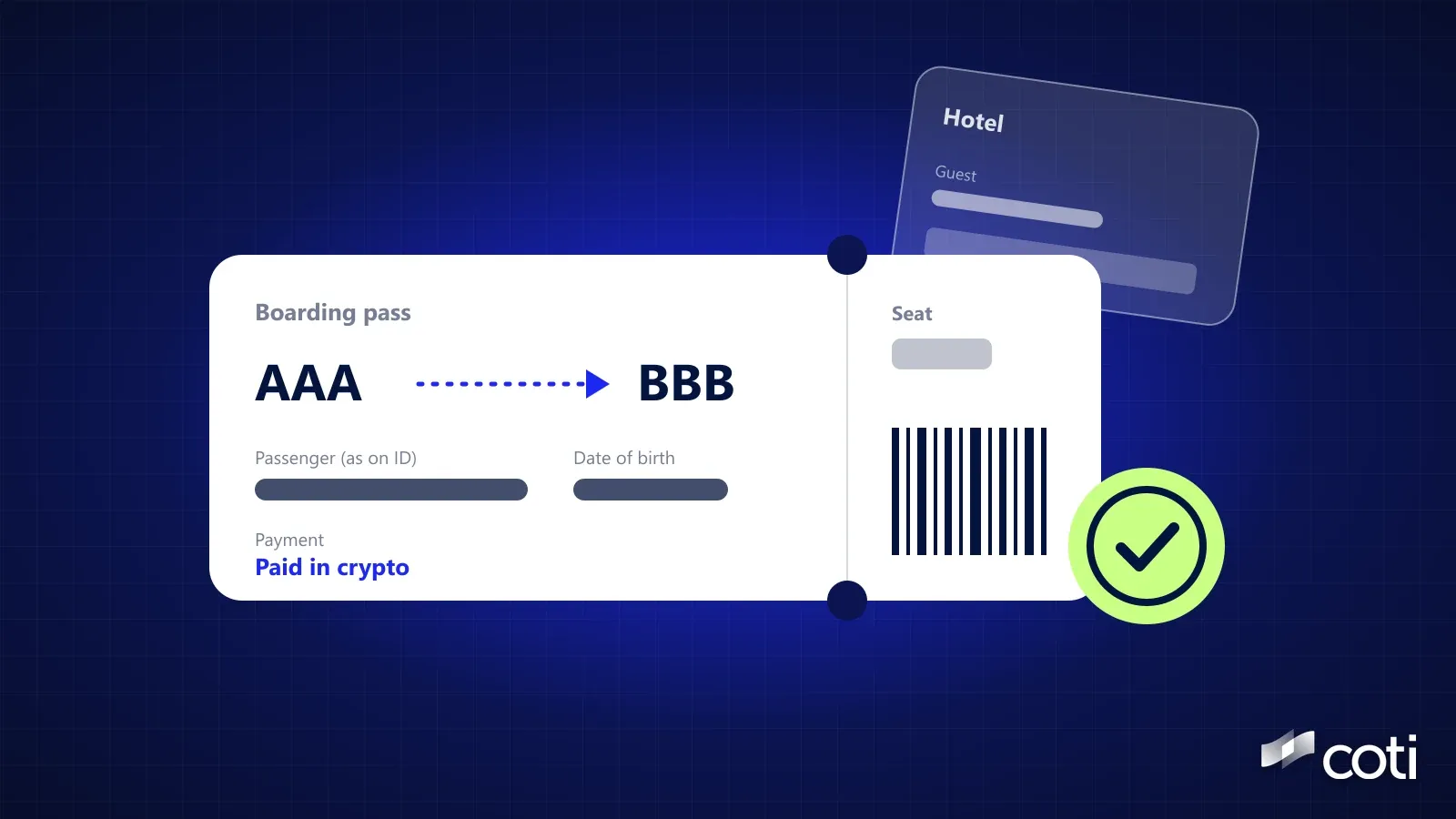
Yes, you can book some flights and hotels with crypto, through airlines and travel sites that accept it or through crypto payment processors. But paying in crypto changes only how you pay. Airlines and hotels still collect your name and other identity details, often because the law requires it, and the crypto payment itself can show the merchant or its processor your wallet address. This guide explains what each party sees and what crypto does and doesn't change.
Current as of October 15, 2026.
The Short Answer
What stays the same when you pay in crypto
- Airlines collect your full name, date of birth and other details for security checks
- Hotels in many countries register guests and check ID
- Booking records for many international flights go to government authorities
What crypto changes
- The airline or hotel doesn't receive a card number for the crypto payment
- Your bank and card network aren't part of the crypto payment, though a crypto platform you pay through can be
What crypto adds
- The payment processor can collect your email, wallet address and IP address
- On a public blockchain, anyone who knows the address you paid from can see its balance and history
What the Airline Collects, Whatever You Pay With
Flight bookings are tied to the passenger, not the payment method.
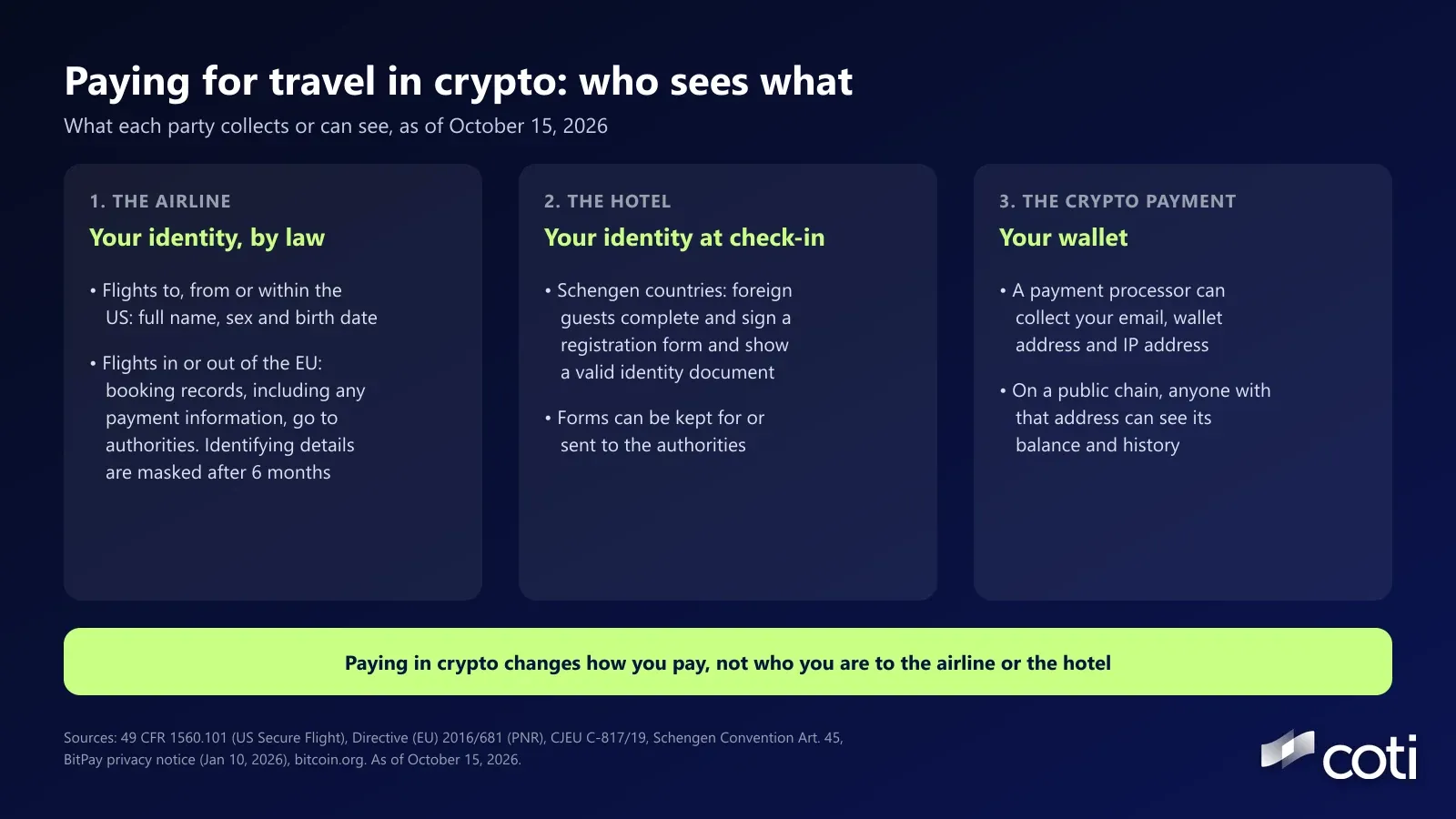
- Flights to, from or within the US: under the Secure Flight rule (49 CFR 1560.101), airlines on what the rule calls covered flights must collect each passenger's full name, sex and date of birth, either at booking or no later than 72 hours before departure.
- Flights into or out of the EU: under the EU PNR Directive, airlines transfer passenger name record data to national authorities. The directive lets each EU country apply it to flights within the EU too, though the EU Court of Justice ruled in 2022 that, without a genuine and present or foreseeable terrorist threat, this must be limited to what is strictly necessary. The list of data elements includes, in the directive's words, "All forms of payment information, including billing address", as far as the airline collects it.
- How long it's kept: the directive sets a five-year retention period. After six months, details that directly identify the passenger, including payment information, are masked, and the full data can be disclosed only under strict conditions, including approval by a judicial or other competent authority. In 2022 the EU Court of Justice ruled that a general five-year retention period applied to all air passengers goes too far, and that after six months data should be kept only where there is objective evidence of a risk linked to that passenger's travel.
So paying in crypto doesn't take you out of these systems. Whatever payment details the airline records are part of the same booking record.
What the Hotel Collects at Check-In
Hotels collect identity details too, often by law. Under the Schengen Implementing Convention (Article 45), Schengen countries ensure that foreign guests, with some exceptions such as accompanying spouses and minors, complete and sign a registration form and confirm their identity with a valid identity document. Those forms can be kept for the authorities or sent to them for purposes such as preventing threats and criminal investigations, unless national law says otherwise. Rules in other countries vary.
A hotel may also ask for a card or a deposit at check-in for incidentals, even if the room is prepaid in crypto. Check the hotel's policy before you travel.
What the Crypto Payment Reveals
When you pay a travel site through a crypto payment processor, the processor usually creates an invoice and you send funds from your wallet. That step reveals new information:
- To the processor: one major processor's privacy notice (last updated January 10, 2026) lists technical information such as your IP address, the products purchased and their price, your email address and your crypto wallet address among the data it collects when you pay an invoice.
- To anyone who knows your address: on Bitcoin, anyone can see the balance and all transactions of an address, as bitcoin.org notes, and other public blockchains such as Ethereum work the same way. So whoever receives your payment can look up the address you paid from, and often link it to other addresses in the same wallet. Our guide to who can see your crypto wallet explains how addresses get linked to names.
Card payments carry their own trail: the card network and your bank see the merchant, amount and time. Our guide to spending crypto privately compares what each party in a payment sees.
Practical Tips Before You Book
- Book in your legal name. Your ticket name must match your ID for security checks, however you pay.
- Check who you're paying. Know whether the payment page belongs to the airline or hotel, a travel site, or a payment processor, and what each asks for.
- Pay from a wallet that holds only what the trip needs. Whoever receives your payment can look up the address you paid from.
- Read the refund terms. For a fully paid invoice, the same processor says refunds are issued for the original fiat value, paid in crypto at the exchange rate when the refund is claimed, to an address you provide. The amount of crypto you get back can differ from what you paid.
- Be wary of claims that an airline accepts crypto. South African Airways issued a customer alert on April 13, 2026: "SAA does not accept Bitcoin or any other cryptocurrency as a form of payment for tickets or services." Check the airline's own website.
Where COTI Fits
- Planned (Q2 to Q3 2027, per COTI's roadmap as of October 15, 2026): COTI Travel, for booking flights and hotels with crypto. The roadmap describes it as designed so that travel merchants and front desks don't see your wallet balance or spending history, only a paid receipt. Our earlier post, a closer look at COTI Travel, describes the idea.
- Planned (Q2 to Q3 2027, per the same roadmap as of October 15, 2026): a virtual card, topped up by private transfer, for paying with Apple Pay or Google Pay.
- What it won't change: airlines and hotels will still collect the identity details the law requires.
Frequently Asked Questions
Can you book flights with crypto?
Yes, in some cases. Some travel sites accept crypto through payment processors, and at least one major airline now offers it on its own website and app. Emirates announced on July 28, 2026 a crypto payment option for eligible UAE residents who hold an account with the crypto platform that runs it, for bookings priced and settled in UAE dirhams. Paying that way makes that platform part of the payment, not just your wallet. Availability varies, so check the airline's own site.
Does paying with crypto keep my trip private?
No. Your identity goes to the airline and the hotel as before, and the crypto payment can reveal your address to the processor, or your account to the platform you pay through. What it avoids is sharing a card number with the merchant.
What happens if my flight is cancelled after I paid in crypto?
It depends on the airline's or travel site's terms and the processor it uses. If the merchant issues a refund, some processors pay back the original fiat value in crypto at the rate when you claim it, so check before you book.
Where to Go From Here
If you pay for travel in crypto, expect to share the same identity details as any other traveller, and choose the wallet you pay from with care. To follow COTI Travel and the virtual card, both planned for Q2 to Q3 2027 as of October 15, 2026, see COTI's roadmap.
Details checked October 15, 2026. Rules and product status can change. Nothing here is financial, legal or tax advice. Emirates, South African Airways and BitPay are not affiliated with COTI. COTI will never ask for your seed phrase or private key, and only COTI's official channels (coti.io, docs.coti.io, COTI's Medium blog and its official X and Telegram) carry announcements.
Sources
- 49 CFR 1560.101: Request for and transmission of information to TSA, US Code of Federal Regulations (Cornell LII copy), accessed October 15, 2026
- Directive (EU) 2016/681 on the use of passenger name record (PNR) data, Official Journal of the EU, published May 4, 2016, accessed October 15, 2026 (Articles 1, 2, 8, 12 and Annex I)
- Press release No 105/22, Judgment in Case C-817/19 Ligue des droits humains, Court of Justice of the EU, published June 21, 2022, accessed October 15, 2026
- Convention implementing the Schengen Agreement, Official Journal of the EU, published September 22, 2000, accessed October 15, 2026 (Article 45)
- Privacy notice, BitPay, last updated January 10, 2026, accessed October 15, 2026
- How do I refund a fully paid invoice?, BitPay support, updated April 17, 2026, accessed October 15, 2026
- Protect your privacy, bitcoin.org, accessed October 15, 2026
- Important customer alert, South African Airways, issued April 13, 2026, accessed October 15, 2026
- Emirates crypto payment launch, Emirates media centre, published July 28, 2026, accessed October 15, 2026
- The freedom to go: a closer look at COTI Travel, COTI, published September 29, 2026, accessed October 15, 2026
- Roadmap, COTI, accessed October 15, 2026