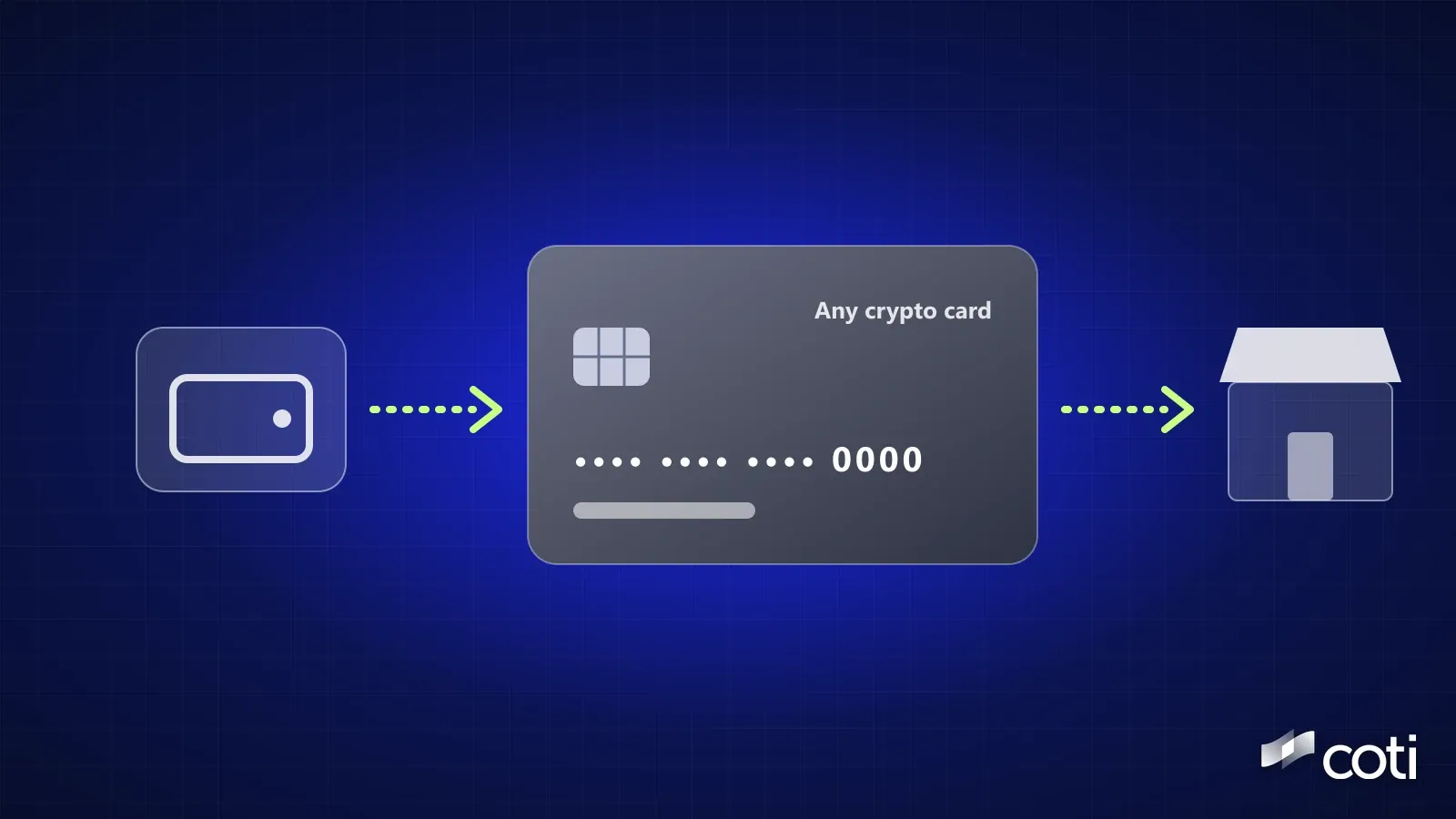
Crypto cards work by converting your crypto into regular money, either when you top up or at the moment you pay, so you can spend it anywhere the card network is accepted. Most crypto cards are debit or prepaid cards, and the merchant receives local currency like any other card payment. For privacy, that means a crypto card works like a regular card: the provider verifies your identity, the card network processes each purchase, and topping up from your own wallet adds a public on-chain record. This guide explains how crypto cards work, who sees what, and why spending can be taxable.
Current as of October 16, 2026.
The Short Answer
How it works
- You hold crypto with the card provider, or top up from your own wallet
- The provider converts it to regular money, before or at the moment you pay
- The merchant is paid in local currency through the card network
Who sees what
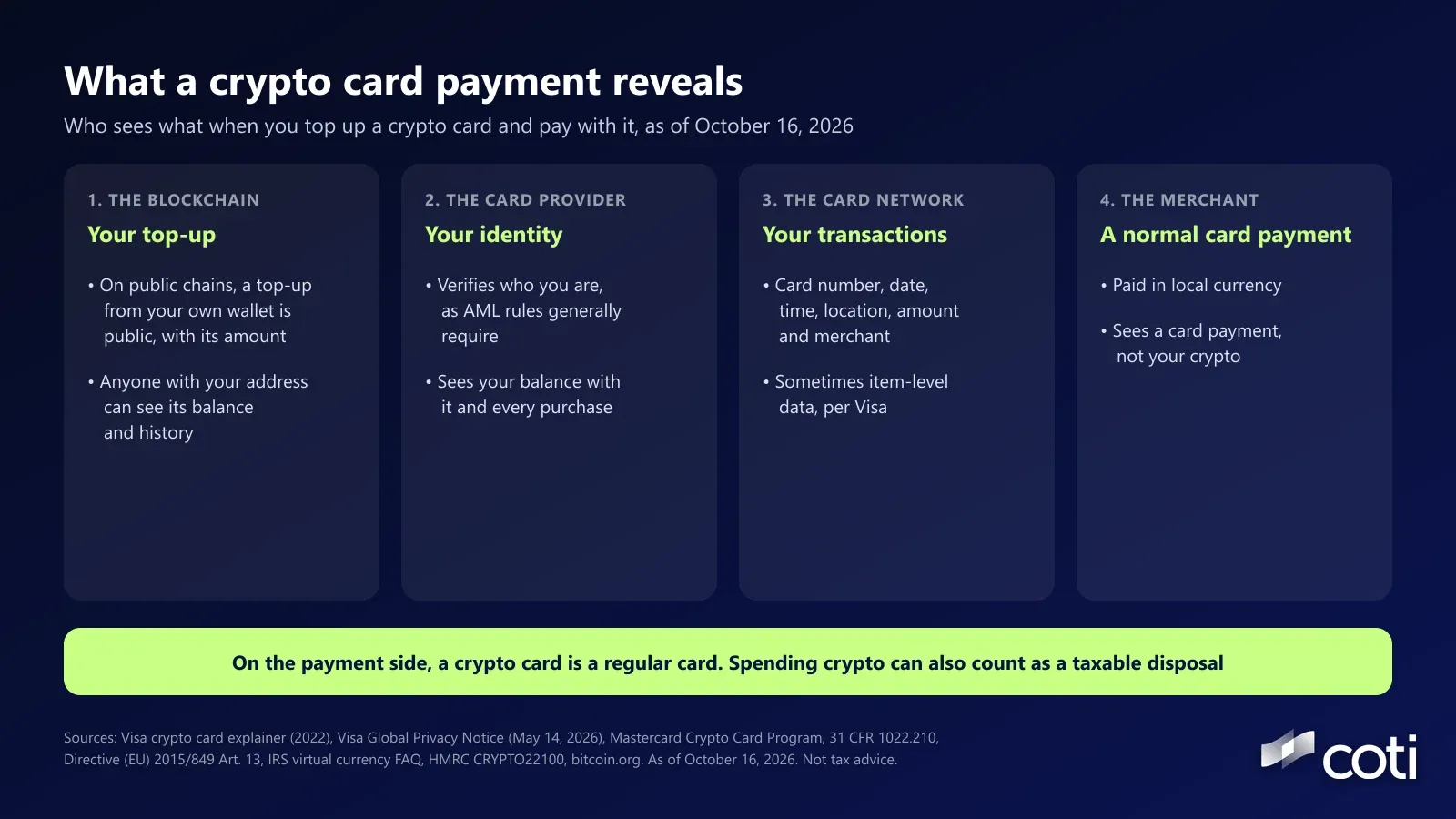
- The card provider: your identity, your balance with it and every purchase
- The card network: your card number, and each purchase's date, time, location, amount and merchant (per Visa's privacy notice)
- The merchant: a normal card payment
- The blockchain: any top-up from your own wallet
One more thing
- US and UK tax guidance treats spending crypto on goods as a sale or disposal, which can be taxable
How Crypto Cards Work
Visa describes two common models. In a 2022 explainer, Visa says some programs make you convert crypto into regular money first, preloading the card, while others convert your crypto at the point of sale when you buy something. Either way, Visa says a conversion to fiat happens so the merchant is paid in local currency, and the cards are issued by partners that hold a Visa license, such as an issuer processor or a BIN sponsor, working with crypto exchanges or platforms.
Mastercard's program page (archived May 15, 2026) describes the same outcome. It says real-time crypto-to-fiat conversion, which depends on the program, means merchants are always paid in fiat, with no change to the usual checkout.
The result is that your crypto never reaches the shop. In the words of Visa's 2022 explainer: "To the merchants and acquirers, these crypto-linked transactions look the same as if they were any other Visa transaction."
Who Sees What When You Pay
The card provider: your identity and your spending
Card providers that fall under anti-money-laundering rules generally have to verify who you are. Two examples:
- United States: under 31 CFR 1022.210, a money services business that provides or sells prepaid access must have procedures to verify the identity of a person who obtains it under a prepaid program, and collect their name, date of birth, address and identification number. Banks that issue cards follow their own customer identification rule, 31 CFR 1020.220.
- European Union: the Anti-Money Laundering Directive, which EU countries apply through national law, requires obliged entities, including banks and other financial institutions, to carry out customer due diligence, which under Article 13 (as amended in 2018) begins with identifying the customer and verifying their identity from a reliable and independent source.
The provider also holds your balance and sees every purchase you make with the card.
The card network: each transaction
Visa's Global Privacy Notice (effective May 14, 2026) says the personal information it collects can include your card number and details of your transactions: the date, time, location and amount, and information about the merchant. It adds: "This also may include item-level data in some instances."
The merchant: a normal card payment
The merchant sees a card payment in local currency, plus whatever you give it at checkout, such as your name, email or delivery address. The payment itself doesn't carry your crypto or your wallet address.
The blockchain: your top-ups
If you top up the card by sending crypto from your own wallet, that transfer is an ordinary on-chain transaction. On public blockchains, anyone who knows your address can look up its balance and history, as our guide to who can see your crypto wallet explains.
Spending Crypto Can Be Taxable
When the card converts your crypto to pay for something, tax authorities may treat that as disposing of the crypto.
- United States: the IRS digital assets page (updated September 2, 2026) lists exchanging digital assets for property, goods or services among the transactions to report on your tax return. Its virtual currency FAQ says that if you exchange virtual currency held as a capital asset for other property, including goods, you recognise a capital gain or loss. The FAQ notes it generally applies to transactions before January 1, 2025, and only to virtual currency held as a capital asset.
- United Kingdom: HMRC's Cryptoassets Manual lists using tokens to pay for goods or services as a disposal.
So a card that converts crypto at the point of sale can create a disposal with every purchase. With a preload card, the conversion at top-up is the disposal. Keep records, and check with a tax adviser where you live. Nothing here is tax advice.
What a Crypto Card Doesn't Change
- It isn't more private than a regular card on the payment side. The provider and the card network see the same kinds of details as with any card.
- It doesn't skip identity checks. Regulated providers generally have to verify customers, as above. Be cautious with any card that promises otherwise.
- It doesn't hide your top-ups. A transfer from your own wallet is public on most blockchains.
Practical Tips
- Find out who actually issues the card. The terms should name the issuer and the card program behind the brand.
- Read the privacy policy. Check what the provider shares with partners.
- Check how conversion works. Know whether you preload or convert at the point of sale, and what rate and fees apply.
- Top up from a wallet that holds only what you need. The provider can see the address you send from.
- Keep records. You may need them for tax.
Where COTI Fits
- Planned (Q2 to Q3 2027, per COTI's roadmap as of October 16, 2026): a virtual Visa or Mastercard card you can top up by private transfer and use with Apple Pay or Google Pay. Our earlier post, a crypto card built for everyday privacy, describes the idea.
- What a private top-up could change: COTI's roadmap says you'll be able to top up the card by private transfer. In COTI's Privacy Portal today, balances and transfer amounts stay encrypted on-chain, according to COTI's docs. Your wallet address, the timing and the step of moving tokens into private form stay visible, as our guide to who can see your crypto wallet explains. COTI hasn't published how card top-ups will work in detail, as of October 16, 2026.
- What it won't change: as with any card, the card issuer and the card network would see your purchases.
COTI hasn't yet named the card's issuer or published its terms, including identity checks, as of October 16, 2026.
Frequently Asked Questions
Are crypto cards private?
Not more than a regular card. The provider verifies your identity and sees your purchases, and the card network processes each transaction. What a crypto card changes is how the card is funded, not who sees the payment.
Does the merchant know I paid with crypto?
Usually not. Visa says crypto-linked transactions look the same to merchants as any other Visa transaction, and Mastercard says merchants are always paid in fiat.
Do crypto cards report to tax authorities?
It depends on the provider and where you live. In the US, brokers report certain digital asset sales and exchanges on Form 1099-DA, starting with transactions on or after January 1, 2025. EU countries have applied the DAC8 crypto reporting rules from January 1, 2026. In the UK, crypto service providers must file their first reports, covering 2026, by May 31, 2027. Whether your card spending is included depends on how the program is set up, so check its terms. Either way, spending can be taxable. Our guide to who can see your crypto wallet covers these reporting rules.
Where to Go From Here
If you use a crypto card, treat it like any other card for privacy, and keep records of what you spend for tax. To follow COTI's virtual card, planned for Q2 to Q3 2027 as of October 16, 2026, see COTI's roadmap.
Details checked October 16, 2026. Rules and product status can change. Nothing here is financial, legal or tax advice. Visa and Mastercard are mentioned for reference only and don't endorse this article. COTI will never ask for your seed phrase or private key, and only COTI's official channels (coti.io, docs.coti.io, COTI's Medium blog and its official X and Telegram) carry announcements.
Sources
- Crypto-linked cards one-pager, Visa, 2022, accessed October 16, 2026
- Mastercard Crypto Card Program, Mastercard, archived May 15, 2026, accessed October 16, 2026
- 31 CFR 1022.210: Anti-money laundering programs for money services businesses, US Code of Federal Regulations (Cornell LII copy), accessed October 16, 2026
- Directive (EU) 2015/849 on the prevention of the use of the financial system for money laundering, Official Journal of the EU, as amended by Directive (EU) 2018/843, accessed October 16, 2026 (Article 13)
- 31 CFR 1020.220: Customer identification programs for banks, US Code of Federal Regulations (Cornell LII copy), accessed October 16, 2026
- Global Privacy Notice, Visa, effective May 14, 2026, accessed October 16, 2026
- Digital assets, IRS, updated September 2, 2026, accessed October 16, 2026
- Frequently asked questions on virtual currency transactions, IRS, last reviewed June 30, 2026, accessed October 16, 2026
- CRYPTO22100: Cryptoassets for individuals, Capital Gains Tax, HMRC Cryptoassets Manual, updated November 28, 2025, accessed October 16, 2026
- Protect your privacy, bitcoin.org, accessed October 16, 2026
- COTI Privacy Portal, COTI documentation, accessed October 16, 2026
- A crypto card built for everyday privacy, COTI, published September 29, 2026, accessed October 16, 2026
- Roadmap, COTI, accessed October 16, 2026