Digital euro privacy depends on who is looking. The European Central Bank says it would see only pseudonymised data and could not directly link payments to you, your bank would still identify you under anti-money-laundering rules, and offline payments would be known only to you and the person you pay. That is the design the ECB describes as of October 7, 2026. The law that would fix it in place is still being negotiated, and EU data protection authorities have asked for stronger guarantees. Here is what each party would see, what has been decided, and what hasn't.
Current as of October 7, 2026. The digital euro doesn't exist yet. This guide describes the proposed design.
The Short Answer
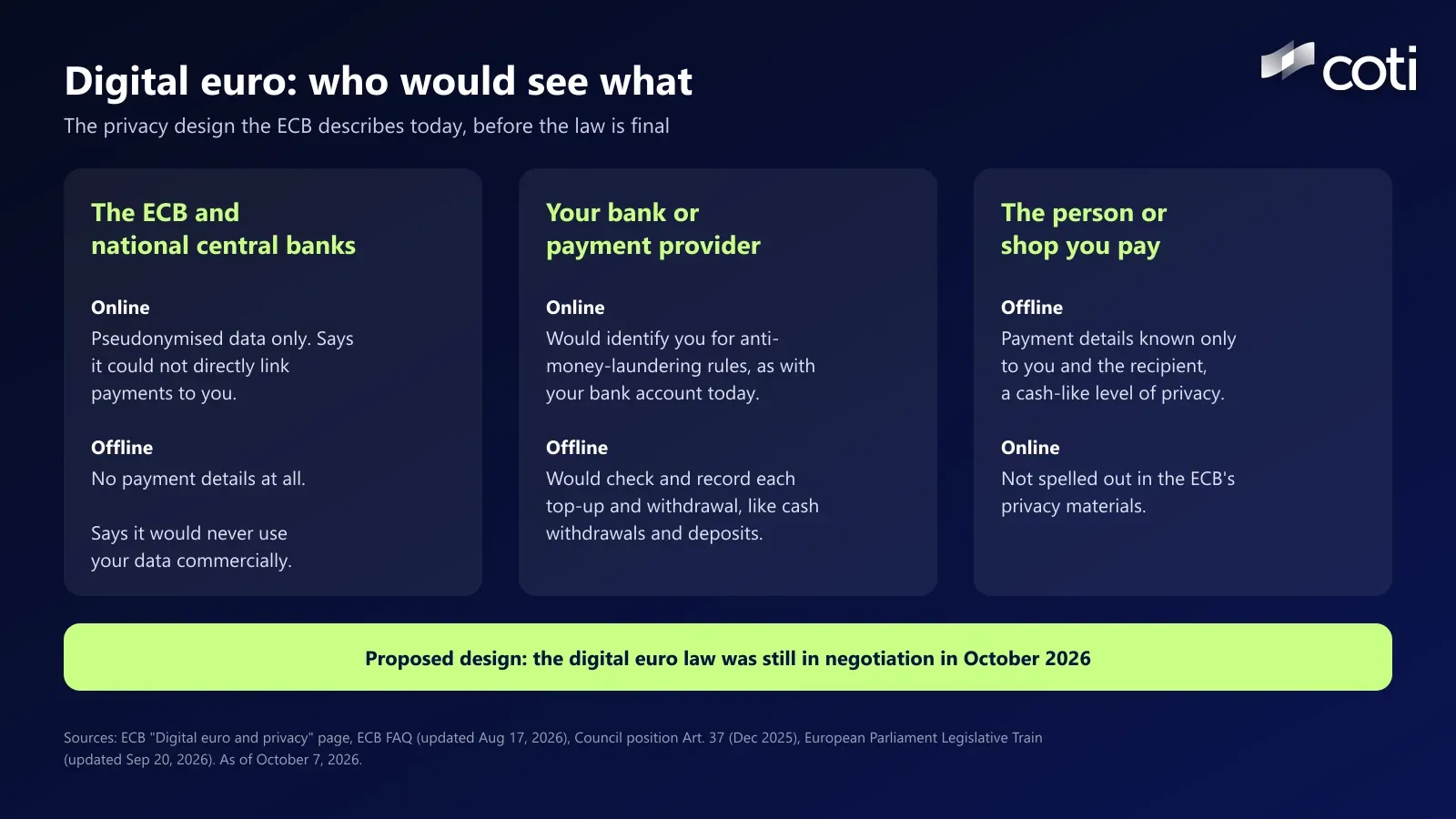
The ECB and national central banks
- Online: would see pseudonymised data only, and says it could not directly link payments to you
- Offline: would get no payment details, which stay between you and the recipient
- Says it would never use your data commercially
Your bank or payment provider
- Online: would identify you for anti-money-laundering rules, as your bank does today
- Offline: would run its checks and keep a record when you load and unload funds, like a cash withdrawal or deposit
The person or shop you pay
- Offline: payment details known only to the two of you, which the ECB calls a cash-like level of privacy
- Online: not spelled out in the ECB's privacy materials
Still undecided
- Holding limits, offline limits, the final legal wording on privacy, and whether low-value online payments get extra privacy
What the ECB Would See
The ECB's digital euro privacy page is direct about its own role: "The data available to the ECB would be pseudonymised, meaning that we would not see any personal data that could identify you." The same page says the Eurosystem, meaning the ECB and the national central banks, would not be able to directly link you to your payments, that it would never use your data for commercial purposes, and that independent data protection authorities would supervise it.
Pseudonymised is not the same as unidentifiable. It means data is stored under a code instead of your name, so linking it back to you requires information held somewhere else. That is why what your bank holds matters as much as what the ECB promises.
The ECB has also ruled out one common fear. Its digital euro FAQ, updated August 17, 2026, says the digital euro would never be programmable money, though it could support conditional payments, such as paying on delivery for an online order. The Commission's 2023 proposal already ruled this out, and the Council's December 2025 position keeps the rule in Article 24: the digital euro shall not be programmable money.
What Your Bank or Payment Provider Would See
You wouldn't hold digital euro with the ECB directly. You would use it through a bank or another payment service provider, and they would know who you are. The ECB's FAQ says that for online payments, providers would be able to identify users to comply with anti-money-laundering rules, as is already the case with the bank account you have today.
The ECB's privacy page adds two limits. Intermediaries like your bank would only have access to the personal data needed to comply with EU law, and any commercial use of your data would need your explicit consent.
Holding limits are still open
To stop money draining out of bank deposits, the plan includes a cap on how much digital euro one person could hold. No limit has been set. The ECB's FAQ says it tested hypothetical holding limits of up to €3,000 per person at the co-legislators' request, and found no harm to financial stability even in an extreme scenario. The ECB presents €3,000 as the top of a hypothetical range it was asked to test, not as a decided limit. Under the Council's position, the ECB would set the limits within a ceiling defined by the Council. The European Parliament's Legislative Train, updated September 20, 2026, notes that holding limits are still not discussed at political level.
Offline Payments: The Closest Thing to Cash
The offline version is where the digital euro's privacy is strongest. According to the ECB, the details of an offline payment would only be known to you and the recipient, which it describes as cash-like privacy.
There is still a checkpoint. The ECB's FAQ says anti-money-laundering checks would be carried out by your payment provider when you fund and defund your offline holdings, just as with cash withdrawals and deposits today.
The Council's position spells out what that means in Article 37. Offline payment data would not be retained by payment providers or central banks. But your provider would keep a record of each top-up and withdrawal (the amount, the identifier of your offline device, the date and hour, and the account numbers used) and make it available to financial intelligence units and other authorities on request. The Commission would also set offline transaction limits, offline holding limits or both. So your provider would know how much you load and when, but not where you spend it offline.
What the EU's Privacy Watchdogs Asked For
The European Data Protection Board and the European Data Protection Supervisor reviewed the Commission's proposal in their Joint Opinion 02/2023, adopted October 17, 2023. They welcomed the offline option and privacy by design, and they asked for more:
- A binding rule, not just a recital. The proposal mentioned pseudonymisation only in a recital, the non-binding preamble of the law. The watchdogs asked for a binding obligation ensuring "pseudonymisation of all transaction data vis-à-vis the ECB and the national central banks." The Council's December 2025 position adds one in Article 34: payment providers must make sure any data sent to the ECB and national central banks is pseudonymised. Whether it survives the negotiations is still open.
- More privacy for small online payments. They regretted that the proposal dropped a selective-privacy approach for low-value online payments, and recommended a threshold below which such payments would not be traced for anti-money-laundering purposes.
- Clearer limits on central data. They asked for the necessity and proportionality of a single access point for user identifiers, and of an optional ECB fraud detection mechanism, to be justified.
Whether those requests end up in the final law is one of the things the negotiations will settle.
Where the Law Stands in October 2026
- June 28, 2023: the European Commission proposed the Regulation on the establishment of the digital euro, COM(2023) 369 (per the EDPB-EDPS opinion).
- December 2025: the Council of the EU adopted its negotiating position, including ECB-set holding limits within a Council-defined ceiling. The ECB dates it December 19, 2025.
- June 23, 2026: the Parliament's Economic and Monetary Affairs Committee adopted its position by 43 votes to 14, with 1 abstention.
- July 9, 2026: the Parliament's plenary endorsed starting negotiations with the Council. The ECB's FAQ, updated August 17, 2026, says those three-way negotiations have started.
- July 14, 2026: the ECB selected 36 payment service providers for a 12-month pilot due to start in the second half of 2027. The pilot version will not have legal tender status.
- September 15 and 28, 2026: the ECB opened a call for online and mobile merchants to join the pilot (deadline October 27, 2026) and a new wave of innovation platform activities (deadline November 9, 2026).
The ECB's October 2025 closing report on the preparation phase says it aims to be ready for a potential first issuance during 2029, assuming the Regulation is adopted in the course of 2026. According to its FAQ, whether to issue is still a separate decision for the ECB once the law exists.
Privacy by Policy vs Privacy by Cryptography
Our take: most of the digital euro's privacy, as described today, comes from rules and system design. The ECB promises pseudonymisation, banks are limited to what the law requires, and supervisors check both. That can work well, but it depends on the legal wording, which is exactly why the watchdogs asked for a binding obligation rather than a recital.
The other approach is to keep data encrypted even while it is processed, so access depends on who holds the keys, not only on a policy promise. That is the problem COTI works on. COTI's network uses a cryptographic technique called Garbled Circuits to compute on encrypted data. In COTI's own Privacy-on-Demand documentation, applications send encrypted inputs and receive encrypted outputs, while metadata such as timing can still be visible. In COTI's design, the application operator decides what is disclosed and to whom, as COTI described in an August 3, 2026 post. COTI announced on September 16, 2026 that Privacy-on-Demand is live on Avalanche.
COTI took part in the ECB's digital euro innovation platform in 2025, one of about 70 market participants. The ECB's September 2025 outcome report on its digital euro innovation platform lists COTI (as Tchain LTD) among the pioneers, the participants that tested conditional payments in a simulated digital euro environment between February and May 2025. COTI announced its participation on May 5, 2025. Taking part in that experiment doesn't mean COTI is building the digital euro, and the ECB's report doesn't describe any single participant's results.
Frequently Asked Questions
Will digital euro payments be as private as cash?
Offline payments would come closest. The ECB says their details would be known only to you and the recipient, though your provider would still run checks when you load or unload funds. Even offline, your provider would keep a record of each top-up and withdrawal under the Council's position. Online payments would be less private than cash, because your bank or payment provider would identify you, as it does today, while the ECB would see only pseudonymised data.
Will the digital euro replace cash?
No, not under the current plans. The ECB's FAQ says the digital euro would complement cash, not replace it. The Council adopted its position together with measures on the role of cash, which the European Parliament's Legislative Train describes as a framework for both digital and physical public money. The EDPB and EDPS also noted that users would always have the choice between cash and the digital euro.
Where to Go From Here
The digital euro's privacy rules will be set in the next stage of negotiations, so the details above may still change, and we'll update this guide when they do. If you want to see how privacy works when it is enforced by cryptography instead of policy, read COTI's Privacy-on-Demand documentation, or read how the COTI Privacy Portal handles confidential transfers on COTI's network.
Details checked October 7, 2026. The digital euro is a proposal, and its design and timeline can change. Nothing here is financial or legal advice. COTI is not affiliated with the ECB or the EU institutions named here. COTI will never ask for your seed phrase or private key, and announcements only come through coti.io, docs.coti.io and COTI's official channels.
Sources
- Digital euro and privacy, European Central Bank, accessed October 7, 2026
- FAQs on the digital euro, European Central Bank, updated August 17, 2026, accessed October 7, 2026
- Closing report on the digital euro preparation phase, European Central Bank, published October 2025, accessed October 7, 2026
- ECB selects 36 payment service providers to join digital euro pilot, European Central Bank, published July 14, 2026, accessed October 7, 2026
- Call for online and mobile merchants to participate in digital euro pilot now open, European Central Bank, published September 15, 2026, accessed October 7, 2026
- Call for expressions of interest in a new wave of digital euro innovation platform activities, European Central Bank, published September 28, 2026, accessed October 7, 2026
- Digital euro innovation platform: outcome report, European Central Bank, published September 26, 2025, accessed October 7, 2026
- EDPB-EDPS Joint Opinion 02/2023 on the digital euro proposal, European Data Protection Board and European Data Protection Supervisor, adopted October 17, 2023, accessed October 7, 2026
- Legislative Train: Digital euro, European Parliament, updated September 20, 2026, accessed October 7, 2026
- Council negotiating mandate on the digital euro, ST 16695/25, Council of the European Union, December 2025, accessed October 7, 2026
- Operator-Defined Privacy: Inside the Cryptography That Powers COTI, COTI, published August 3, 2026, accessed October 7, 2026
- COTI x Avalanche: Privacy Built for Business, COTI, published September 16, 2026, accessed October 7, 2026
- COTI Joins CBDC Project as Pioneer of ECB's Digital Euro, COTI, published May 5, 2025, accessed October 7, 2026
- Garbled Circuits, COTI documentation, accessed October 7, 2026
- What is Privacy-on-Demand, COTI documentation, accessed October 7, 2026
- COTI Privacy Portal documentation, COTI, accessed October 7, 2026